Categories
Budgets Improving Bus Service Just Growth Just Growth Champions Measure M Public Participation Resources Social Equity transportation equity Transportation Finance Uncategorized

How We Got Here: Three Decades of Equity at Metro

When Metro merely mitigates for inequitable impacts of already formed projects, Metro sustains economic disparities to resources and opportunity throughout greater LA.

Today, Metro attempts to achieve equitable outcomes by minimizing disparate impacts on new projects. Metro projects routinely include mitigation measures to compensate for the parts of a project they see negatively impacts communities that Metro defines.

Metro’s attempts to compensate for inequitable (read: unfair) impacts per project might appease project concerns. However, this approach alone cannot counteract the scale to which enduring hardships weigh on people whose livelihoods rely on LA’s public transportation system.

Compensation plus systems change is needed to address inequity’s root cause. Discriminatory public policy like redlining starts with exclusionary thinking and abets discriminatory outcomes when applied to investments over time. Rather, Metro can achieve fair (read: equitable) outcomes by acknowledging the role its legacy has played in the past. In their Equity Platform Framework, Metro acknowledges that “historically and currently, inequity exists and has been largely defined by race and class – as well as age, gender, disability, and residency. Metro commits to working with historically underserved communities to establish meaningful equity goals.”

Once Metro’s choices reflect a trend of more equitable outcomes then Metro can more genuinely engage with the public to shape and fulfill initiatives that not only lower travel burdens but also transform underserved communities’ access to resources and opportunities. Metro’s 10-year strategic plan (Vision 2028), which the board adopted in 2018, further commits the agency to equitable outcomes. Here, the author of this article recaps Metro’s prior missteps and reviews the agency’s current attempts to more equitably serve LA’s residents and visitors than Metro has in the past.


How has Metro involved equity in the past?

Since April 1993, the state of California has authorized Metro to plan, fund, build, and operate LA County’s transportation system [1]. However, Metro has not always carried out its duties fairly. In fact, over the last three decades Metro has gone from being sued for overlooking its most vulnerable customers to now mitigating for inequitable outcomes of Metro initiatives. Next, Metro should prospectively apply equity to transform greater LA into a thriving region.

Below is a summarized timeline of how Metro has involved equity in the past.


I. Mandated compliance with Bus Riders Union/Metro consent decree


Long before Metro’s founding in 1993, LA transportation officials ambitiously sought to grow a rail transit system that effectively outshined their efforts to cultivate a robust and reliable bus network. In the early 1990s, LA County bus riders — who overrepresented LA County’s population of people of color — shouldered the burden of the regions’ investment in growing a rail network (arguably still the case today). For instance, in 1992, Metro’s buses “carried 94 percent of the agencies ridership, yet the agency dedicated less than a third of its annual budget to bus operations.” At the same time, an overwhelming majority of the agency’s budget (71 percent) went to budding rail programs “that served only 6 percent of Metro’s ridership” [1, p. 163].

While the total number of rail riders was limited by a scant rail network at the time (only Metro’s Blue line was open by 1992), transportation officials willingly decided to invest in rail transit to an extent that dwarfed their investment in bus transit. Rail transit generally costs transit agencies more than bus transit to build and operate because of the many expensive components of rail transit like installing steel tracks and electrical power systems. Although bus passengers in the early 1990s were crowding onto Metro’s buses, transportation officials failed to invest in ways that would directly alleviate overcrowded buses by buying more buses or by operating buses more frequently and reliably in dedicated bus lanes, for example. In spite of this paradigm, LA’s transportation officials in 1994 proceeded to propose a fare increase whose burden would fall heavily on Metro’s bus riders, while simultaneously spending on expensive rail expansion.

In 1994, the Bus Riders Union (an organized coalition of bus riders) and their attorneys from the NAACP’s Legal Defense Funds (LDF) successfully stopped Metro’s proposed fare hike. In 1996, U.S. District Court Judge Terry Hatter Jr. ruled that such a fare hike would result in “disparate impacts” to the Metro’s bus riders who were over 80 percent people of color. By comparison, people of color comprised of less than 60 percent of LA County’s population at the time [1]. Now popularly known as the ‘consent decree,’ this court order precipitated a cap on Metro’s transit fares for 10-years (which has since expired in 2006) and required Metro to buy more buses to alleviate overcrowding. Significantly, this intervention shifted Metro’s attention to address the needs of their current (mostly bus) riders who overwhelmingly represented low-income communities of color, which remains the case today.


II. Indirect attempts to apply equity in planning


In the first decade of the 2000s Metro remained the rail, bus, and highway agency it had already been for more than three decades. Metro’s 30-year (long-range) transportation planning (LRTP) document from 2009 reflects transportation officials’ continued rail building ambition. It also shows how relatively little investment and attention Metro pays to enhance walking and biking infrastructure, which enable basic human-powered mobility. Metro’s 2009 plan dedicates a mere one percent of the agency’s planned investments over 30 years to improve biking and walking linkages to transit (see 2009 LRTP, Figure F) — outspent twice over by ‘Administration and Other’ costs and thirteen times over by ‘Street and Road’ costs, which until recently have been designed with a singular focus: how to make it easier to drive a private automobile.
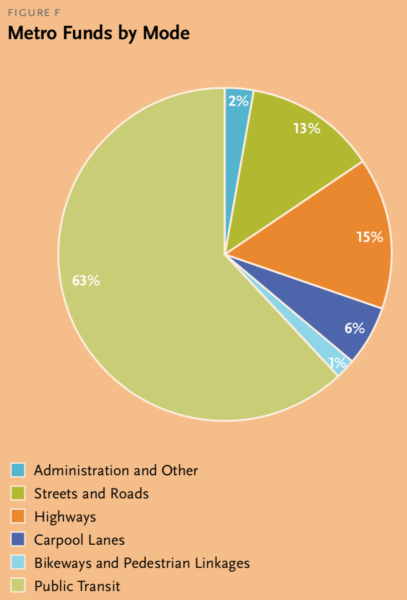
 

Source: Metro’s 2009 Long Range Transportation Plan, p. 15


The 2009 LRTP does not address nor ameliorate mobility disparities based on race and income. Although the 2009 plan includes a ‘job accessibility’ metric to show mobility disparities, Metro fails to address the implications of these disparaging metrics. The 2009 plan accepts weak outcomes like taking three decades to achieve small gains. For example, Figure 11 of the 2009 plan (copied below) shows that Metro will take 30 years to lower transit commute times to under an hour for a small additional (12 percentage point) share of transit dependent neighborhoods, which have mostly carless, low-income, or senior households. The 2009 plan ignores the remaining 41 percent of work trips from transit dependent neighborhoods that will take more than an hour by transit for, at least, another 30 years.
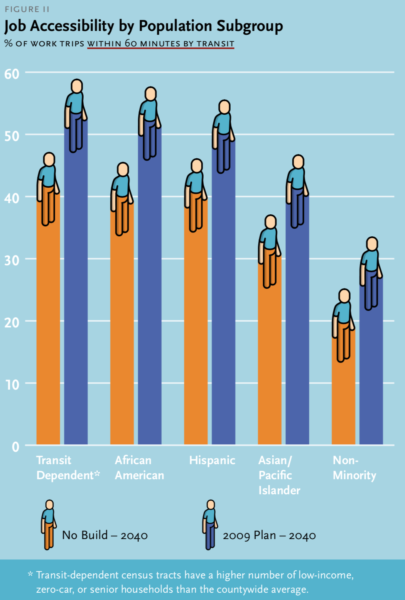
 

Source: Metro’s 2009 Long Range Transportation Plan, p. 54 (red underline added for emphasis)


Secondly, the same ‘Environmental Justice’ section of the 2009 plan overstates the positive impact the 2009-plan proposed projects could have on communities of color. For at least 30 more years (through 2040), around half of LA County’s African American, Hispanic, and Asian American ‘subgroups’ and around 70 percent of ‘non-Minority subgroups’ will remain over an hour away from work by transit — an outcome that reflects the need for transportation officials to focus more meaningfully on changing their relationship with policies that govern housing and job growth, which underlie people’s need to travel. Finally this 30-year plan focuses heavily on work trips largely sustaining difficulty for people whose access and independence relies on transit.


III. Broadening the agency’s engagement with local officials and advocates


In the current decade, Metro accounted for city-controlled infrastructure by committing Measure M funds to cities through two programs: the ‘Multiyear Subregional Program’ (MSP) and continuing the ‘Local Return’ program. Metro also lowers cities’ costs of applying for state transportation funds by assigning Metro staff to write grant proposals for cities. Metro offers this service, called Technical Assistance, to cities free-of-charge.

In the years leading up to 2016, Metro officials built a broad-based coalition that included local officials and advocates to campaign for a sales tax measure, which officials expect will raise $120 billion over 40 years for transportation purposes. Subsequently, Metro’s CEO convened a Policy Advisory Council to help develop the 2020-50 Long Range Transportation Plan “and other work plans and policy areas that the Metro Board may request.” When the measure passed, coalition members representing local jurisdictions, consumers, and other transportation providers gained seats on the Metro Policy Advisory Council (PAC). Members of the PAC’s ‘consumers’ constituency group especially advocate for social equity.

In 2018, Metro Board adopted a 10-year strategic plan (Vision 2028), which validates equity’s importance to fulfilling Metro’s mission. In the plan Metro commits to prioritize communities with need, but stops short of designating who in the agency would guide and how they would hold the agency accountable to its equity commitment. At a public meeting in February, Metro CEO Phil Washington alluded to hiring an officer to champion equity for Metro. We support this notion and urge Metro to hire a CERO – Chief Equity & Race Officer – with multiple staff to define equity and set performance measures, which reinforces all four pillars of the Equity Platform Framework and helps fulfill Vision 2028 strategic goals.

Also in 2018, Metro directors promised to prioritize investments to communities based on need by adopting the Equity Platform Framework. With the framework, Metro challenges its staff to approach every decision with the goal of achieving equitable outcomes countywide. Immediately, the framework should impact how Metro redesigns Metro’s bus network (NextGen), develops a 2020-50 Long Range Transportation Plan, deliberates which projects to accelerate, designs a congestion pricing program, and distributes Measure M’s Active Transportation Funds.


What’s next? Centering equity at the outset of every initiative

In the next decade, Metro must move equitable decision-making from the margins to the center of all of its work. When Metro’s directors recently approved their initiative to “Reimagine LA County,” they reaffirmed their commitment to achieve equitable and sustainable outcomes through mobility. Later this month, Metro’s directors will have a chance to anchor equity in Metro’s congestion pricing and TNC fee studies at the outset.
Categories
Budgets Public Participation Resources Transportation Finance Uncategorized

How LA’s Budget Shapes Priorities

Ever wonder why so many sidewalks in Los Angeles are broken, narrow, or missing altogether? Decades of funding decisions that have not prioritized the public right-of-way—sidewalks, streets, and related infrastructure—are part of the answer.

Ever wonder how to improve a local park, library, streetlight, or public service? When residents ask elected officials to fix infrastructure or expand services, they often hear the same response: “If it’s not in the budget, we can’t do it.”

While budget allocations do not always translate immediately into visible improvements, they directly influence what residents can expect from their local government. In that sense, a city’s budget is a reflection of its priorities. It reveals what elected officials believe they can accomplish and what they are willing to invest in during the coming year.

City of LA Budget 101

The City of Los Angeles fiscal year begins on July 1 and ends on June 30 of the following year. The annual budget, adopted each June by the Mayor and City Council, serves as the City’s spending and revenue plan for the upcoming fiscal year.

A FY20 budget, for example, refers to the fiscal year running from July 2019 through June 2020.

Although the City Council ultimately approves the budget, many important decisions are made long before budget hearings begin. Department staff, the Mayor’s office, and the City Administrative Officer (CAO) all play significant roles in shaping the budget before it reaches the Council.

A Simplified Budget Timeline

September–November: Department leaders develop budget requests and submit them to the Mayor.

November–April: Department leaders, the Mayor’s office, and the CAO review funding needs and priorities.

April: The Mayor releases a proposed budget and outlines priorities for the coming fiscal year.

May: The City Council Budget and Finance Committee holds public hearings on departmental budgets.

June: The City Council adopts the budget before the new fiscal year begins on July 1.

How Can You Get Involved?

When engaging in the City’s budget process, we recommend three basic steps.

1. Relationships Matter

Anyone seeking to influence public spending should understand who helps shape budget decisions.

Key players include department leadership, staff in the Mayor’s office, budget staff, and members of the City Council’s Budget and Finance Committee. Building relationships and understanding how decisions are made can help residents and advocates engage more effectively.

2. Know Your Issue

If you are asking the City to fund a service or improve infrastructure, it helps to understand how that request might be paid for and maintained over time.

Some useful questions include:

  • What funding source could support the proposal?
  • Who would maintain it?
  • What are the long-term costs?
  • Have other cities successfully implemented similar programs?

Strong ideas are often strengthened by practical funding and implementation strategies.

3. Show Support

Elected officials are more likely to respond when they see broad community support.

Public testimony, sign-on letters, partnerships, neighborhood organizing, and public awareness campaigns can all demonstrate that an issue matters to residents. The most effective advocacy often combines strong relationships with visible public support.

A Vision Zero Case Study

One example of how priorities become investments is Vision Zero.

In 2015, Mayor Eric Garcetti launched Vision Zero, Los Angeles’ initiative to eliminate traffic deaths. LADOT developed plans identifying dangerous corridors and outlining strategies to improve safety.

Advocates, community members, and elected officials then worked to elevate Vision Zero during the budget process.

Funding grew from approximately $3 million to $27 million in FY18 and then to $37 million in FY19.

That increase reflected a growing recognition that traffic deaths are preventable and that street safety requires sustained investment.

Budget allocations alone do not save lives. Implementation matters. But without funding, plans often remain plans.

Why This Matters

City budgets are where priorities become real.

They reveal what a city values, where resources are directed, and what improvements residents can reasonably expect in the years ahead.

For anyone seeking better sidewalks, safer streets, improved parks, stronger transit, or more effective public services, understanding the budget process is essential.

The budget cycle is active nearly year-round. By understanding how it works, building relationships, and organizing around shared priorities, residents can play a meaningful role in shaping the future of Los Angeles.

Categories
Completing Streets Public Participation Social Equity transportation equity Uncategorized

It’s time to Stop Trippin’: Fixing the City of LA’s Sidewalks

Sidewalk Policy Frequently Asked Questions (FAQ)


Why are close to half of the 11,000 miles of the City of Los Angeles in disrepair?

Some estimates put the amount of damaged sidewalks in the City of Los Angeles at 4,600 miles. Given that sidewalks are the most fundamental piece of our transportation system that impacts all travel modes, how did we get to this point?
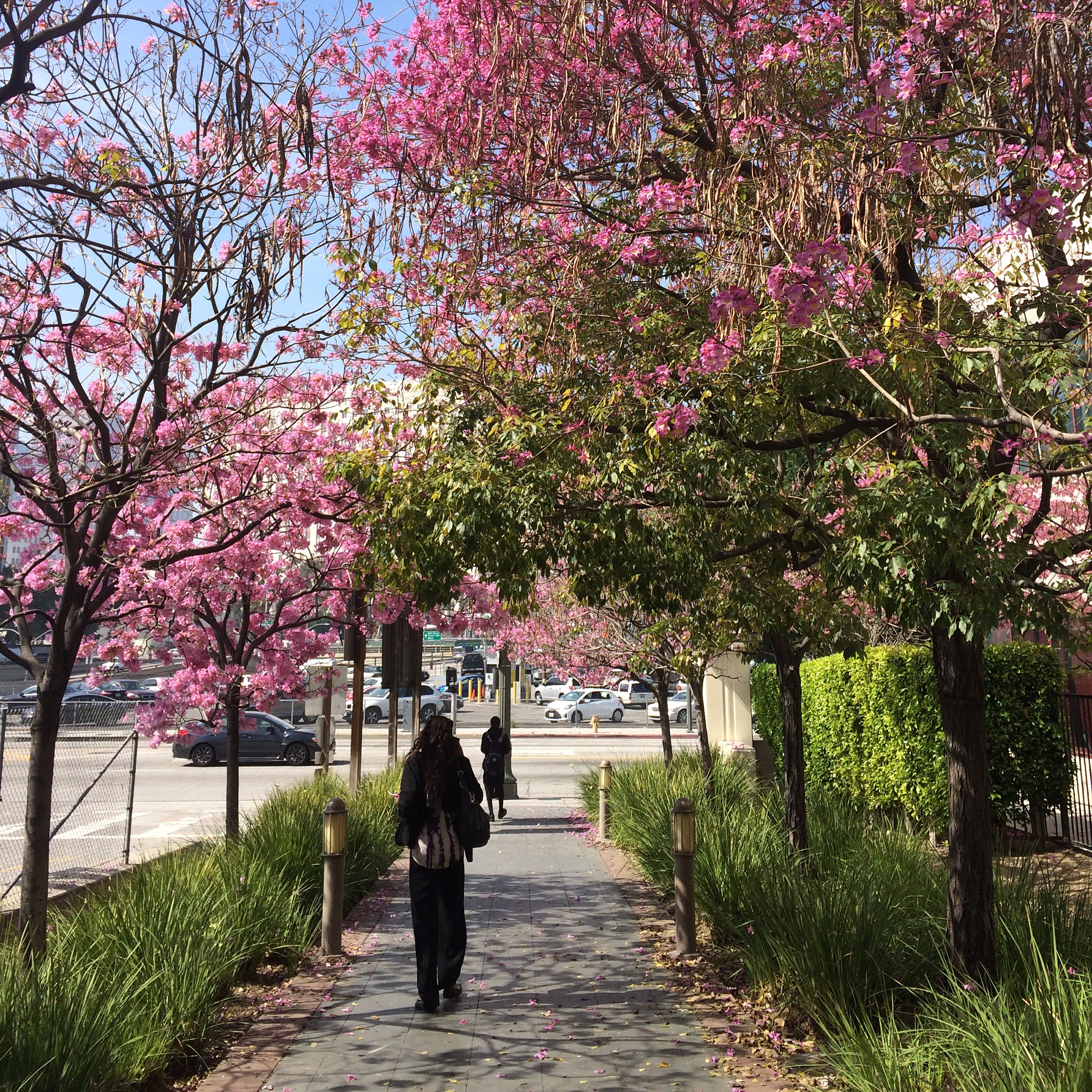
 

In the 1970s, the City of Los Angeles took on financial responsibility for sidewalks damaged by trees. Previously, property owners were financially and legally responsible for adjacent sidewalks.

But within a few years the City ran out of dedicated funding to repair sidewalks and stopped making repairs and installing needed accessibility fixes.  It has been over 40 years since the City of Los Angeles has invested in a comprehensive program to fix and maintain its sidewalks, crosswalks, and bus stops. This is painfully evident with deteriorating conditions and lack of accessibility for all citywide.


Thanks to partners in the disability advocacy community in 2015 the City settled a $1.4 billion class action lawsuit, commonly known as the “Willits Settlement.” The settlement determined that the City’s crumbling sidewalk infrastructure was not compliant with the Americans with Disabilities Act (ADA) and prevented people with disabilities from travel and access in Los Angeles. This legal action led the City to develop a sidewalk policy. More info on the Willits Settlement below.


What is the new Sidewalk Policy?

In 2015 the City of Los Angeles finalized the Willits Settlement, a $1.4 billion class action lawsuit and largest disability lawsuit nationwide, over the City’s broken sidewalks preventing people with disabilities from traveling around. The settlement requires that the City invest $1.4 billion in sidewalk repair, which will be stretched over 30 years and starting at a minimum of $31 million annually, including:


  • Install install, repair, and upgrade curb ramps
  • Repair sidewalks and walkways damaged by tree roots
  • Repair broken or uneven pavement
  • Correct non-compliant cross-slopes in sidewalks


Upon fixing a sidewalk to meet ADA compliance, the City will then “release” liability of that portion of sidewalk to the adjacent property owner. Further repairs and liabilities for the repaired sidewalk would no longer be the City’s responsibility. This is commonly referred to as “Fix-and-Release.”


The City is collecting data to map every sidewalk, street tree, curb ramps, and street tree to create a robust inventory of sidewalk conditions. This will inform a citywide prioritization process to identify what streets to start repairing first. The City will also integrate “Low Impact Development” principles, such as conserving natural areas and retaining stormwater runoff where possible.


How does this impact me?

After the Willits Settlement, the City of Los Angeles developed a Sidewalk Repair Program to prioritize sidewalks in disrepair. There are four program categories:


  1. Sidewalk Access Repair Program: Requests by and for people with disabilities
  2. Rebate Program: Property owners willing to pay for their sidewalk and eligible for rebate
  3. Program Access Improvements: General public requests
  4. City Facilities Program: Prioritizing broken sidewalks adjacent to City-owned property


Under the first three categories, residents and property owners can initiate requests or work on repairs in identified locations. All requests can be made online at: http://www.sidewalks.lacity.org/ or by calling 311. The City Facilities Program was formed to address the Willits settlement requirement that all sidewalk segments adjacent to City-owned properties to meet ADA-compliance in the first five years of the program. Details on each program category are below.


What is the Access Repair Program?

The Sidewalk Access Repair Program is a 20% annual set-aside for sidewalk repair funds to directly address disabilities access requests. Through the Access Program people with disabilities may submit requests for access repairs such as curb ramp installations and tree root fixes along specific paths of travels. The City has set a goal to remediate access requests within 120 days of receiving a request. Requests are prioritized by a scoring criteria that awards more points to requests made a) in residential neighborhoods, b)  within 500 feet of a transit stop/station, and c) unresolved requests dated more than 120 days. All requests can be made online at: http://www.sidewalks.lacity.org/. Also you can call 311 or use the MyLA311 app.


What is the Rebate Program?

The Rebate Program rewards property owners who initiate and pay for their own sidewalk repairs through private contractors through a monetary rebate. Residential and commercial owners can receive a rebate up to $10,000. Property owners must apply with the City to participate in the program, then pay for their own repairs. Once certified by the City that the repairs are ADA-compliant, the property owner then receives the City’s valuation offer amount, up to $10,000. All requests can be made online at: http://www.sidewalks.lacity.org/. Also you can call 311 or use the MyLA311 app.


What are the Program Access Improvements?

Program Access Improvements allows the general public and others to report a sidewalk, curb ramps, or other pedestrian facilities in need of repair in the public right-of-way. These requests are not specifically tied to an access issue for a person with a disability and follow the same prioritization scoring system as the City Facilities Program (see below). Because the City has prioritized repairing all sidewalks adjacent to City-owned property in the next five years, and City departments charged with responding to sidewalk repair requests have limited capacity,  general residential requests are not likely to be addressed for at least five years. All requests can be made online at: http://www.sidewalks.lacity.org/. Also you can call 311 or use the MyLA311 app.


What is the City Facilities Program?

The City Facilities Program allows for the repair of sidewalks, curb ramps, or other pedestrian facilities at City government offices and facilities, including pedestrian rights-of-way adjacent to facilities owned or operated by the City and the paths of travel leading to primary entrances.


The City Facilities Program uses a two-tier prioritization method. Tier 1 assigns points based on the sidewalk segment location, adjacent land use, proximity to the Vision Zero High Injury Network (HIN), and number of incident reports. Segments with the highest Tier 1 points total will receive field assessments that scores the sites on damage severity and repair costliness (Tier 2). Segments with the highest combined Tier 1 and Tier 2 scores would be prioritized for repair. Proposed prioritization scoring details are currently being finalized by the City.


What does this mean for street trees?

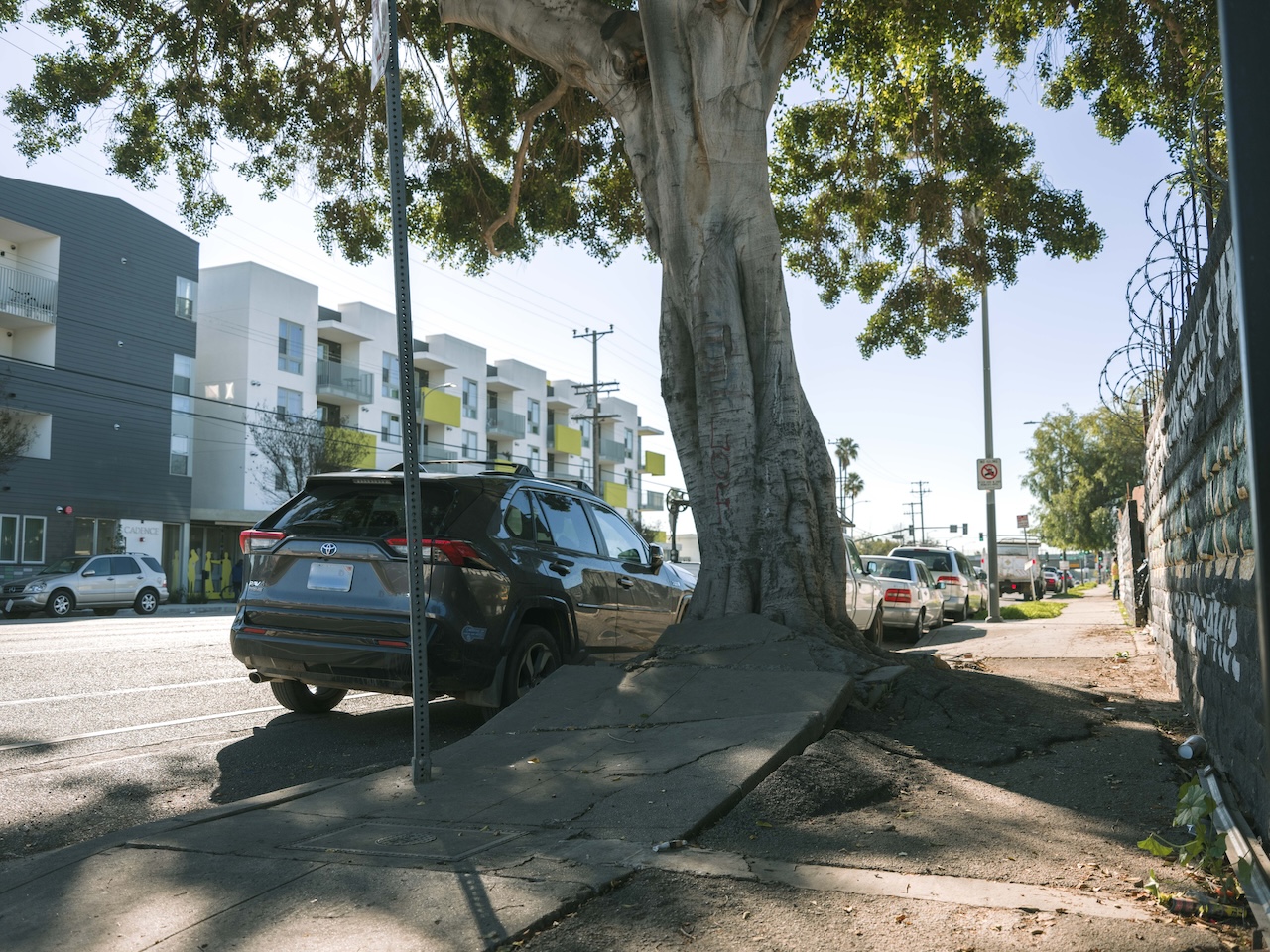
While some sidewalk disrepair in the City of Los Angeles is created by tree roots, a full tree canopy is an essential part of a comfortable sidewalk and neighborhood. Trees lifting the sidewalk were either not appropriately selected when planted, have had infrastructure built up around them, or have not been properly maintained. When following the practice of “right tree, right place,” such tree and sidewalk conflicts can be avoided.


As Los Angeles experiences more and more extremely hot days, the Sidewalk Repair Program should be designed in a way to retain protective tree canopy. The City currently has a policy of a 2:1 tree replacement ratio for any street tree removal. However this does not take into account mature tree size, so removing a ficus tree with a 50-foot canopy and replacing it with two small stature trees is not going to have the same shade benefits that were previously being provided to that community.


Of course, planting appropriate trees that can grow in these spaces that will not cause infrastructure damage is important. But keeping public health and community benefits in our neighborhoods is just as important and requires thoughtful planning. The Community Forestry Advisory Committee (CFAC) has recommended the City adopt a replacement ratio based on canopy size than number of trees. There would still be a delay in the benefits of mature trees for the subsequent years it will take for the trees to grow to maturity but this ensures a comparable canopy in the long-run. Healthy and mature trees are already being replaced through the Sidewalk Repair Program, and a more robust and revised replacement policy can address this concern.

Note: Sidewalks graphics courtesy of Los Angeles Bureau of Engineering

*****END OF FAQ*****

Vision for a Comprehensive Transportation Network


The Sidewalk Repair Program is an opportunity for the City of Los Angeles to address its most basic quality-of-life infrastructure. Safe and comfortable sidewalks and crosswalks serve all travelers, improve local economy, and can create vibrant public gathering spaces.


Rather than treated as separate from streets and transit, planning and funding sidewalks should be considered part of a comprehensive transportation network. We look forward to a future where our city is connected by a robust sidewalk and crosswalk network with ample shade and amenities, access to transit with safe and dignified bus stops, patrons connected to commercial and cultural destinations, stormwater runoff treatments, and safe passage for travelers of all ages and abilities.


This future requires a data-driven strategic master plan that defines transportation with all travel modes and paths of travel in mind. Los Angeles is often touted as being in the midst of a transportation revolution. We are in a unique position to receive unprecedented transportation and infrastructure resources, including Measure M and state SB 1 funds. It is critical to develop a cost-efficient process to effectively leverage public funds and create a transportation system that will support our transit expansion, first/last mile demands, and ensure safety and accessibility for all travelers. A strategic master plan that incorporates the entire public realm (from sidewalks and streets to bus stops and crosswalks), also creates a system for the multiple City departments who oversee infrastructure and transportation to coordinate efforts and resources. This leads to better and faster outcomes for residents and business owners who rely on city services for their daily quality-of-life amenities.


A comprehensive transportation network will ensure the City of Los Angeles its highest return on investment in the public realm and create a safe, clean, comfortable path of travel for everyone, regardless of ability, resources, or travel mode. This transportation revolution can not leave our sidewalks behind as they are the most universal piece of transportation infrastructure the City oversees. Let’s not let it fall through the cracks.

Categories
Public Participation transportation equity Transportation Finance Uncategorized

Investing Measure M’s Local Return to Fix Sidewalks and Streets

Over the past months, most of the attention on Metro’s ballot measure has been, understandably, on the major transit and highway projects planned by Metro. But, for many of us working at the neighborhood level, the important caveat is: the measure would also generate billions of dollars for local projects in the City of Los Angeles and every other city in the county. That means opportunities to re-invest in our sidewalks, crosswalks, and streets — the crucial but often forgotten infrastructure that helps get us to our transit stations or bus stops.

Like Propositions A and C and Measure R before it, Metro’s ballot measure (what might be coined “Measure M”) would include a substantial local return program. Local return is a formula funding program that distributes money to local jurisdictions for street and sidewalk repair, municipal transit operations, capital projects, and other transportation purposes based on population.

Metro’s Measure M would allocate 17 percent of the new ballot measure revenue to local return, which would increase to 20 percent after 2039. By our estimate, this would generate over $130 million per year for all 88 cities and the County of Los Angeles, including over $50 million per year for just the City of Los Angeles (due to the fact the City of LA represents approximately 40% of the County’s population). If you’re a City Manager, public works or streets services official, elected official, or a transportation advocate in any of LA County’s cities, you have a timely opportunity to advocate for where local return funding should go.

In May, two motions were introduced at Los Angeles City Council, kicking off the discussion of how the City of Los Angeles might use the revenue from its share of local return from the potential ballot measure.

Local return is an important revenue source for cities to maintain their local transportation infrastructure. Most cities use their local return to operate small bus systems, to repave streets and repair sidewalks, and to leverage state and federal grants for capital projects. Metro’s Measure M proposes to expand eligibility to include stormwater capture and transit-oriented communities.

With so many competing demands on a limited funding source, it is important for cities to set clear priorities to use local return funding efficiently and effectively to achieve desired policy outcomes. For more background on local return in the City of Los Angeles, see our policy brief from our webinar in May.

As discussed in our brief, Investing in Place’s priorities with local return are:

  • To prioritize projects based on need,
  • To integrate complete streets and green streets into street repair, and
  • To set aside 20 percent of funding for sidewalks, crosswalks, bike lanes, bus stops, safe routes to school, and other related projects that address safety and access for people traveling on foot or bicycle, as recommended in the City’s Mobility Plan 2035.

These policies will maximize the benefits of the potential measure for Los Angeles’ neighborhoods, deliver improvements more cost effectively, and prioritize the safety of the city’s most vulnerable residents.

When this issue was last discussed by council members in May, the Transportation Committee considered the two local return motions, heard testimony from the public — including many of our partners — and directed city staff to report back with a more comprehensive proposal for using the new revenue in line with the City’s adopted policy priorities, including Mobility Plan 2035, the Safe Routes to School Strategic Plan, Vision Zero, and more.

Taking a pause to consider the magnitude of potential investment and the best way to prioritize all of these needs is a win for advocates, giving us time to engage with staff and council offices to articulate a more holistic approach to transportation funding in the City of Los Angeles.

Stay tuned for updates as this discussion continues at Transportation Committee possibly in August or in the early fall and consider signing onto our letter (to be drafted in early August) outlining Investing in Place’s priorities for local return in the City of Los Angeles.  To join our local return working group efforts and/or learn more, please email jessica@investinginplace.org.

Categories
Public Participation Social Equity transportation equity Transportation Finance Uncategorized

Ballot Measure Recap: What Did We Win?

Two years ago, over 60 #metrofundwalkbike advocates attended a Metro Planning & Programming Committee meeting on the Short Range Transportation Plan, setting off a series of actions and incremental victories for walking and biking in Los Angeles County.

Last month, our efforts culminated in a ballot measure expenditure plan that would spend over $4 billion* (2015 dollars) on walking, biking, and connecting our residents to transit stations and bus stops over the next 40 years. Dubbed the Los Angeles County Traffic Improvement Plan, Metro’s measure will go before voters in November and needs two-thirds support to pass.

In the last few months, our coverage focused on the changes we were pushing for and we scored some significant wins in the revised plan while defending all the great projects that were included in the March draft. Now that the dust has settled after the final plan’s adoption, it is clear that the ballot measure is a huge leap forward for walking and biking in Los Angeles County and includes funding to make our communities safer, healthier, and more equitable.

That doesn’t mean our work is done — far from it. We still need to better define what we mean by transportation equity, to focus on parts of the county that are falling behind like the Gateway Cities, and to grow the voices of local champions on these issues.

While our work continues, it is important to recognize that all of our future victories will be easier in an environment where there is robust funding for transit, streets, and the rest of our transportation system. The November ballot measure — Measure M — is a critical piece of that equation. As Metro and the campaign start to educate voters about the measure, here’s a recap of what Measure M would do for walking and biking:

1. Integrate First and Last Mile Access to Transit into All Projects

With the recent opening of rail lines in the San Gabriel Valley and the Westside, there’s been a lot of coverage about whether people can easily access the new lines. Up until now, people walking and biking to transit have been an afterthought in transit planning, but those days are over — Metro’s recent Quality of Life report found that a vast majority of transit users get to the train station or bus stop without a car.

One of the most significant revisions in the final expenditure plan was the addition of an innovative policy to fund first and last mile improvements near new transit stations. The policy would require cities to contribute three percent of the cost of new transit projects and allow them to use that money to make improvements for walking and biking in the vicinity of the new stations. We called the Active Transportation Strategic Plan a “game changer” because it helps build an integrated transportation system that truly connects neighborhoods to transit. Our initial estimate values these improvements at about $300-500 million over the life of the measure.

2. Finish Los Angeles River and San Gabriel Valley Greenways

Los Angeles County has an extensive network of greenways along our rivers, railroad rights-of-way, and other corridors. These paths provide important links to schools, parks, and other community destinations.

For some long-distance bike commuters, the paths provide efficient, traffic-free routes to transit stations and regional job centers. But this network is incomplete, with missing links that prevent people from fully utilizing the system. Many of these missing links are in park-poor communities without safe places for children and families to be physically active.

Measure M includes funding to close the gap in the Los Angeles River bike path through Downtown Los Angeles and open to the public some of the tributaries to the San Gabriel River that are currently behind locked gates. The result will be a connected bike path network for preschoolers with training wheels, people who love riding for miles on end, and everyone in between who would be able to use high-quality bike paths to meet their friends and family, to get to work or school, and more. The measure allocates over $650 million for these projects.

3. Fund Safe Routes to School and Other Active Transportation Programs and Projects

Each subregion had the opportunity to set aside funding for walking, biking, and safe routes to school, depending on local priorities. (For more about Los Angeles County’s nine subregions, see our memo on Councils of Governments.) Nearly all subregions did. These programs vary in name, description, and funding levels, but they all set aside funding for future active transportation needs. Eligible uses would include infrastructure like sidewalks, crosswalks, and bike lanes, and programs like safe routes to school, public education campaigns, and open streets events.

Funding and investments will be controlled by the subregion, so it is important for advocates to get involved in setting the priorities, including which specific projects and programs should be funded in each part of the county.

Here’s how much each subregion set aside for walking, biking, safe routes to school, and complete streets programs:

Measure M - active transportation funding

4. Require Complete Streets in All Projects

All projects in the ballot measure are governed by Metro’s Complete Streets Policy, which requires projects to incorporate the needs of people walking, biking, and taking transit. While we had asked for this policy to be included directly in the ballot measure ordinance, the fact is that complete streets is already required and has been since 2014. Metro staff is still working on updating planning procedures to ensure that all projects comply with the policy, and advocates will need to keep a watchful eye on projects to make sure that they do, but voters should feel comfortable that even the highway projects included in the measure will make accommodations for people walking, biking, and taking transit.

5. Repair Streets and Sidewalks

Fixing streets and sidewalks is the responsibility of local jurisdictions, but many cities haven’t had enough funding to keep their sidewalks in good condition and make them accessible for people with disabilities.

Metro’s final expenditure plan increased local return up to 20 percent with the expectation that cities will use this funding to make infrastructure improvements. To make sure voters understand this commitment (and at our urging), Metro included sidewalk repair right alongside fixing potholes in the 75-word ballot summary that voters will see:

Sidewalks are an essential part of the transportation system, so it is critical for cities to have the resources to maintain them.

6. Fund Countywide Walking and Biking Programs

In addition to all of the funding described above, Metro has reserved $857.5 million — about $20 million per year — for programs and projects that serve the whole county. This would provide a stable funding source for ongoing program costs currently subject to the uncertainty of grant funding, like safe routes to school, bike safety classes, public education campaigns, open streets, and bike share. Stable funding is essential for these programs to grow and reach the maximum number of residents possible. This funding might also be used for capital projects with countywide significance, or maintenance and operation of active transportation infrastructure.

And So Much More…

These walking and biking programs are just one piece of what the measure would do. It also includes dedicated funding for transit maintenance in perpetuity, yet-to-be-identified bus rapid transit projects, expanded bus and rail operations, and enhanced service for students, seniors, and people with disabilities. This all adds up to a remarkably balanced, forward-looking plan that makes significant investments in our communities. The measure is a strong foundation for us to build on to create truly safe, healthy, and equitable communities and we are pleased to support it.

To learn more about our work on defining transportation equity in Los Angeles County, please register to join us at The California Endowment for a partner’s convening on September 12.

*The sum of all projects and programs included in the expenditure plan with a primary purpose of enhancing walking and biking (“active transportation”) is $3.9 billion. Some of these programs also include other related purposes that might not be exclusively for walking and biking, such as complete streets and first/last mile improvements. This $3.9 billion estimate does not include the potential value of Metro’s new first/last mile policy that integrates walking and biking improvements near new transit stations into the transit project budget, which could add another $300-500 million for walking and biking. All estimates are in 2015 dollars.

Categories
Public Participation Social Equity Transportation Finance Uncategorized

What a win for Investing in Place & our partners looks like in Metro’s Draft Expenditure Plan

A couple of months ago, we released our analysis of Metro’s draft expenditure plan, covering what’s promising and what’s concerning about Metro’s proposed uses for about $120 billion in potential revenue, or even more from a 45 or 50-year measure that is scheduled to go before Los Angeles County voters in November 2016. Before that can happen, the Metro Board of Directors need to approve an expenditure plan for the ballot measure.  The final expenditure plan is expected to be reviewed by the Metro Board in June. As we get closer to the Metro board’s decision about a final plan, we wanted to provide a recap where we are and where we still need to make progress for the ballot measure to deliver key benefits for our communities with this potential new funding.

In our March 2016 analysis, we praised Metro leadership for funding transit operations and state of good repair, planning for new bus rapid transit lines and transit-oriented communities, and creating new services for students, older adults, and people with disabilities in the draft expenditure plan. We also applauded Metro for dedicating about six percent of the measure for projects and programs that directly serve trips made on foot or bicycle, and an additional three percent for complete streets projects where safety for people walking and biking is the central purpose of the expenditure. (Metro’s own pie chart shows only two percent for active transportation, however many walking and biking projects are in the transit and highway categories.) Together, these projects and programs that focus on making Los Angeles County safer and more accessible to people walking and biking account for about nine percent of the measure. It is still less than what’s needed, but it’s a good start.

There are still missed opportunities that should be fixed before the expenditure plan is finalized to ensure that all communities are served by the potential ballot measure. As we wrote in our analysis, the draft expenditure plan’s funding for active transportation is both inadequate and inequitable. There isn’t enough money overall for walking, biking, and safe routes to school and, more importantly, some communities were entirely left out of the limited active transportation funding that was included. Without investing in safe streets for all communities, the measure falls short of its potential. In our comment letter, we called this a “fatal flaw.”

There are also policy changes that would clarify how walking and biking are integrated into other projects through complete streets and first/last mile access. Integrated planning should be written directly into the ordinance to provide assurance to voters that commitments to complete streets are enforceable. These changes would maximize the value of investments in transit and highways by making sure that all projects consistently deliver benefits for people who walk and bike.

Here’s what a win for Investing in Place and our partners looks like:

  1. Dedicated Funding for Active Transportation in the Gateway Cities

There is no way around the fact that some of Los Angeles County’s most environmentally impacted and lowest-income communities of color are located in the Gateway Cities subregion. Cities like Cudahy, Pico Rivera, Bell, and Compton are emerging as regional leaders on walking, biking, and safe routes to school planning, but just don’t have the resources they need to rebuild streets that haven’t been updated since World War II. Long Beach aspires to be the most bicycle-friendly city in the United States, but would receive no dedicated funding toward their goal under the current proposal. While other subregions will have funding for greenways along the upper Los Angeles and San Gabriel Rivers (and their tributaries), the lower sections of these rivers will see no access improvements.

Screen Shot 2016-04-29 at 3.08.48 PM
At the Southeast cities townhall hosted by Metro in April, participants showed support for walking and biking investments in the area.

Research by the Safe Routes to School National Partnership and LACBC found that while high-resource cities are able to strategically mix local return and other city revenue with state and federal grants to fund walking and biking improvements, low-resource cities like those in southeast L.A. County don’t have local funding to leverage, and are therefore completely reliant on outside funding sources. A subregional program for active transportation — like those proposed for North County, Las Virgenes-Malibu, San Gabriel Valley, Westside Cities, and Arroyo Verdugo — would be a game changer for these cities, especially if it addresses first/last mile conditions, and safe routes to school investments. Based on population and need, a Gateway Cities Active Transportation Program should be funded at $400 to $500 million over the life of the ballot measure, which is about $10 million per year (2015 dollars). This funding could come from reallocating funding from other projects, pursuing innovative financing from new ExpressLanes in the subregion, or extending the sunset date of the measure to generate more revenue. Without dedicated funding for walking and biking, safe routes to school planning, and complete streets in the Gateway Cities from the ballot measure, the most vulnerable residents in the county will continue to have the least safe streets and the worst access.

  1. Clear Commitment to Complete Streets

In October 2014, Metro adopted its award-winning Complete Streets Policy, which firmly commits the agency to provide for the needs of all people in all of it’s projects. The policy recognizes Metro’s role as a planning, funder, builder, and operator of the region’s transportation system working in partnership with cities to improve streets for people who walk and bike. It is Metro’s role as a funder that is particularly important in the formulation of the potential ballot measure and the creation of new projects and programs that will shape the next half-century of transportation in Los Angeles County. This ballot measure needs to reaffirm Metro’s commitment to complete streets in every project and program.

The draft expenditure plan includes an innovative programmatic approach to addressing safety, congestion, and accessibility on arterial streets, led by each subregion. Some of these programs are called “complete streets” in their program titles, and we included these in our funding analysis in March. Others are vague arterial improvement programs without defined purpose or scope. Metro’s Complete Streets Policy should apply to these programs, but since the programs have yet to be defined, that commitment has not yet been articulated.

The potential of these programs is huge. If all arterial programs were developed with strong complete streets guidelines, then over $3 billion (over 7%) of the measure, in 2015 dollars, would go toward building complete streets that improve safety and accessibility for everyone, including people walking, biking, taking transit, and driving.

*In our March analysis, these programs were counted toward an estimated $1.2 billion in complete streets improvements in the draft expenditure plan.

What needs to be in the measure to guarantee Metro’s commitment to complete streets? In San Diego’s TransNet sales tax, complete streets are written directly into the ordinance that goes on the ballot. They use the following language:

All new projects, or major reconstruction projects, funded by revenues provided under this Ordinance shall accommodate travel by pedestrians and bicyclists, except where pedestrians and bicyclists are prohibited by law from using a given facility or where the cost of including bikeways and walkways would be excessively disproportionate to the need or probable use. Such facilities for pedestrian and bicycle use shall be designed to the best currently available standards and guidelines.

If Metro were to use similar language in its ballot measure, voters could be confident that projects funded by the measure will deliver safe and accessible streets in their communities.

  1. Integrated Funding for First and Last Mile Access in All Transit Projects

Last week, the Metro Board considered a motion by L.A. Mayor Eric Garcetti to clarify that first and last mile access will be integrated into all future transit capital projects, building on momentum generated by Metro’s First/Last Mile Strategic Plan and Active Transportation Strategic Plan. An amendment by Inglewood Mayor James Butts would go further by allowing cities to count investment in walking and biking improvements around station areas as part of their required 3% capital contribution for major transit projects. (For more information about this motion, see last week’s blog post.) While the motion passed out of Planning and Programming Committee unanimously, it was continued until June by the board due to questions about the financial impact of the new policy.

What the board realized during discussion of the motion is that while it’s one thing to have a strong policy, what also needs to happen is a commensurate increase in transit project budgets to reflect the expanded scope. These improvements were not a part of the cost estimation process for these projects and should have been. While life-of-project budgets 20 or 30 years in the future already factor in a degree of flexibility to account for future uncertainties, there is nothing uncertain about the need to plan for first and last mile access. We recommend that all major transit capital project budgets be increased by 3 to 5% to account for the addition of walking and biking improvements to their scopes, which would require identifying an additional $325 to $550 million countywide in the expenditure plan. The consideration of 45 and 50-year alternatives provides an opportunity to increase project funding without taking away from other projects and programs.

The board will reconsider the motion at its June meeting, and support from advocates is critical to ensure that Metro makes a financial commitment to first and last mile as part of its transit capital program. If the full board adopts the motion, Metro will be making an unambiguous policy statement that transit projects need to include access for people walking and biking in their project budgets.

Mark Your Calendars: We Need You in June!

Metro will be making big decisions at their June meeting. In addition to the first/last mile motion, the board will consider the entire expenditure plan. This is our final opportunity to make the case that walking and biking need more investment in order to make our communities safer and healthier places to live. Please join us at these meetings and let us know you’re coming by RSVPing on here.

Metro Planning & Policy Committee

Wednesday, June 15th at 2:00 PM

Metro Board Room, 3rd Floor


Metro Executive Management Committee

Thursday, June 16th at 11:30 AM

Metro Board Room, 3rd Floor


Metro Board

Thursday, June 23rd at 9:00 AM

Metro Board Room, 3rd Floor

Categories
Public Participation Social Equity Transportation Finance Uncategorized

City of LA Sidewalk Policy Program proposal

Update on March 9, 2016: The Joint Committee will discuss this item on Monday March 14th at 2pm in City Hall.  Please email us at jessica@investinginplace.org if you plan to attend or are interested in more information. Thank you!

Last week, members of the City of Los Angeles Joint Committee of Public Works and Gang Reduction and Budget and Finance Committee submitted a letter to the City Council with their policy proposals for the City of Los Angeles Sidewalk Program.  Read the complete letter here.

The letter signed by Councilmembers: Paul Krekorian, Joe Buscaino, Nury Martinez and Mike Bonin opens with, “For forty years, the City of Los Angeles has been stuck with a dysfunctional policy when it comes to sidewalks.” This lack of a solid policy for the City’s over 11,500 miles of sidewalks, has created a situation of buckled sidewalks, utilities in the middle of the sidewalks blocking access, missing sidewalks, lack of curbcuts, crosswalks in need of redesign and upgrade, and intersections and paths of travel in need of critical safety and livability fixes and more – this growing list of infrastructure problems totals over $1.5 Billion dollars in need for the City of Los Angeles.

As a result of the lack of sidewalk repair, several years ago plantiffs Mark Willits, Judy Griffin, Brent Pilgreen, and Communities Actively Living Independent and Free (“CALIF”) filed a class action to ensure better access for persons with mobility disabilities to the city’s sidewalks, curb ramps, crosswalks, pedestrian crossings and other walkways. This lawsuit was settled in 2015 and outlines key next steps, as well as mandates the City of Los Angeles invest a minimum $31 Million annual in sidewalk repair.

Concurrent to the sidewalk class action, in June 2014 the Joint Committee of Public Works and Gang Reduction and Budget and Finance began holding hearings and community meetings across the city to engage hundreds of stakeholders in efforts to finally develop a comprehensive sidewalk program. The Joint Committee recommendations now will go before the full City Council for discussion. As outlined in their letter the recommendations are to ensure a City of Los Angeles Sidewalks policy include the following elements:

  1. Incentivize Proactive Repairs by Property Owners
  2. Inspection and Certification
  3. Comprehensive Repair Program
  4. Warranty for Future Damage
  5. Prioritizing and Coordinating Repairs
  6. Demand based Repair Work Coordinated by Council Offices
  7. Division of Labor for the Repair Work
  8. Preserving the Urban Forest While Maintaining Accessibility
  9. Utilizing Non-Standard Sidewalks Designs and Materials
  10. Leveraging the Sidewalk Program, Accelerating Constructions and Alternative Financing Options

For more detail on what these 10 elements should address – we highly recommend partners read the 5 page letter.

What’s unclear to us after reading the letter is: will this program finally create a comprehensive inventory of the City’s 11,500 miles of sidewalks in order to ensure the prioritization, coordination, and acceleration is feasible and developed in a systematic and data driven framework for the entire city?

For several months, Investing in Place has been convening a work group on this pending policy. Supporting the creation of an inventory has become the clear ask from advocates across the city in order to ensure steps are taken to create a comprehensive program.  With the City of Los Angeles budgeted to spend $31 Million by July this year, creating a citywide inventory would be a helpful and pragmatic next step.  For more background, see our comment letter and ideas the Investing in Place workgroup, and AARP submitted to the Joint Policy Committee for fixing the most critical element of the transportation network – the city sidewalk.

Stay tuned as we learn more about this important infrastructure program.

Categories
Public Participation Social Equity Transportation Finance Uncategorized

City of Los Angeles: Sign on to our comment letter and fund sidewalks as part of the transportation network

The City of Los Angeles is considering a policy to address the improvement needs extending over 11,000 miles of sidewalks and paths of travel on Monday November 16th. Investing in Place and partner organizations are concerned that many mobility, safety, sustainability and social equity goals and policies are not being strategically addressed in the recommendations from the City Administrative Offices (5/26/15: New policy for repair and management of sidewalks adjacent to private property).

Therefore, Investing in Place and partners are submitting a comment letter this week and ask others to sign on in support of our recommendations to address these goals. This letter states that we welcome the opportunity to work with the the City to develop a strategic, data driven framework for this policy and work plan. We encourage the City to look beyond sidewalk repairs as simply a budget issue, but to view repairs through a planning lens that examines mobility and quality of life issues,  and not only links but strengthens existing local, regional and state policies and goals. And click here to read AARP’s comments on the proposed policy. Thank you AARP!

Categories
Public Participation Social Equity Transportation Finance Uncategorized

Safe Routes to School: A Model for Data-Driven Investment

As Los Angeles County considers a fourth transportation sales tax measure that could generate tens of billions of dollars for transportation investments, it is important to look at examples of how funding can be prioritized based on data, need, and desired outcomes.

One such example is the City of Los Angeles Safe Routes to School Strategic Plan.

Launched by the Los Angeles Department of Transportation (LADOT) in 2012, the plan was designed to improve safety and mobility for students and families while making the most effective use of limited public resources. Rather than distributing funds based on political boundaries, the plan established a citywide prioritization process to identify schools with the greatest need.

The City evaluated more than 500 public schools using criteria that included:

  • Collision rates near schools
  • The number of students living within walking and bicycling distance
  • The percentage of students eligible for free and reduced-price meals
  • Whether the school had previously received Safe Routes to School funding

A critical component of this effort was the City’s partnership with the Los Angeles Unified School District, which provided data that allowed planners to better understand student travel patterns and needs.

The results demonstrate the value of a data-driven approach. In 2014, LADOT successfully secured more than $20 million through California’s Active Transportation Program to fund safety improvements around nine of the highest-need schools, support education and encouragement programs, and develop school travel plans for the remaining priority schools.

The Safe Routes to School Strategic Plan has also become an important building block for the City’s Vision Zero efforts, providing a framework for using data, safety outcomes, and equity considerations to guide transportation investments.

As Los Angeles County considers future transportation investments, this example offers an important lesson: public funds can be prioritized based on measurable need, clear outcomes, and a shared vision for improving safety, mobility, and public health.

When transportation investments are guided by data and focused on communities with the greatest needs, limited resources can have a greater impact for residents across the region.

New Title

New Name

New Bio

Estolano Advisors

Richard France

Richard France assists clients with strategic planning, visioning, and community and economic development. He is a strategic planner at Estolano Advisors, where he has been involved in a variety of active transportation, transit-oriented development, climate change resiliency, and equitable economic development projects. His work in active transportation includes coordinating a study to improve bike and pedestrian access to transit oriented districts for the County of Los Angeles, and working with the Southern California Association of Governments to host tactical urbanism events throughout the region. Richard also serves as a technical assistance provider for a number of California Climate Investment programs, including the Affordable Housing Sustainable Communities, Transformative Climate Communities, and Low Carbon Transit Operations programs. He has also taught at the UCLA Luskin School of Public Affairs. Richard received a Bachelor of Environmental Design from the University of Colorado at Boulder, and his M.A. in Urban Planning from UCLA.

Accelerator for America, Milken Institute

Matt Horton

Matt Horton is the director of state policy and initiatives for Accelerator for America. He collaborates with government officials, impact investors, and community leaders to shape infrastructure, job creation, and equitable community development efforts. With over fifteen years of experience, Matt has directed research-driven programs and initiatives focusing on housing production, infrastructure finance, access to capital, job creation, and economic development strategies. Previously, he served as the director of the California Center at the Milken Institute, where he produced research and events to support innovative economic policy solutions. Matt also has experience at the Southern California Association of Governments (SCAG), where he coordinated regional policy development and planning efforts. He holds an MA in political science from California State University, Fullerton, and a BA in history from Azusa Pacific University. Additionally, Matt serves as a Senior Advisor for the Milken Institute and is involved in various advisory boards, including Lift to Rise and WorkingNation.

UCLA Lewis Center for Regional Policy Studies

Madeline Brozen

Madeline is the Deputy Director of the UCLA Lewis Center for Regional Policy Studies at the Luskin School of Public Affairs. She oversees and supports students, staff, and faculty who work on planning and policy issues about how people live, move, and work in the Southern California region. When not supporting the work of the Lewis Center community, Madeline is doing research on the transportation patterns and travel needs of vulnerable populations in LA. Her recent work includes studies of low-income older adults in Westlake, public transit safety among university students, and uncovering the transportation needs of women, and girls in partnership with Los Angeles public agencies. Outside of UCLA, Madeline serves as the vice-chair of the Metro Westside Service Council and enjoys spending time seeing Los Angeles on the bus, on foot, and by bike.

Office of Los Angeles Mayor Karen Bass

Luis Gutierrez

Luis Gutierrez, works in the Office of Los Angeles Mayor Karen Bass, as the Director of Energy & Water in the Office of Energy and Sustainability (MOES), Luis oversees issues related to LA’s transition to clean energy, water infrastructure, and serves as the primary liaison between the Mayor’s Office and the Department of Water and Power. Prior to joining MOES, Luis managed regulatory policy proceedings for Southern California Edison (SCE), focusing on issues related to equity and justice. Before joining SCE, Luis served as the Director of Policy and Research for Inclusive Action for the City, a community development organization dedicated to economic justice in Los Angeles. Luis holds a BA in Sociology and Spanish Literature from Wesleyan University, and a Master’s Degree in Public Administration from Cal State LA.

Communications Strategist

Kim Perez

Kim is a writer, researcher and communications strategist, focused on sustainability, urban resilience and safe streets. Her specialty is taking something complex and making it clear and compelling. Harvard-trained in sustainability, she won a prize for her original research related to urban resilience in heat waves—in which she proposed a method to help cities identify where pedestrians spend a dangerous amount of time in direct sun, so they can plan for more equitable access to shade across a city.

EXECUTIVE DIRECTOR

Jessica Meaney

Jessica Meaney is the founder and executive director of Investing in Place.


She has spent more than two decades working across philanthropy, government, and nonprofit organizations in Los Angeles, focused on how cities care for public space. Jessica holds a BA from Prescott College and a master’s degree in urban sociology from California State University, Los Angeles.


Her background in urban sociology shapes how she understands infrastructure, not simply as physical assets, but as reflections of how cities allocate resources, set priorities, and shape daily life. She examines sidewalks, streets, and parks as interconnected civic systems influenced by governance, finance, and institutional design.


At Investing in Place, Jessica leads research, convenings, and long-term analysis of how Los Angeles manages its public realm. Her work increasingly explores how cities structure and sustain public space systems over time, contributing to broader conversations about public governance and the social life of infrastructure.