Categories
Uncategorized

The Hard Part: Implementation

If you read the Los Angeles Times’ recent editorial, “Is LA Getting Serious About Safer Streets?”, you probably left with more questions than answers.

That’s because Los Angeles’ public works and transportation systems are complex, fragmented, and often difficult to understand, even for people who spend their careers working on them.

Two efforts are currently moving forward:

  • A grassroots-led ballot measure that would require implementation of portions of Mobility Plan 2035 when major street improvements occur.
  • A City Council motion intended to advance many of the same goals through a broader policy framework.

Both efforts reflect a growing recognition that Los Angeles needs safer streets and a better system for delivering public infrastructure.

At Investing in Place, we’re particularly interested in what sits beneath both proposals: how Los Angeles plans, prioritizes, funds, and coordinates investments in the public right-of-way.

The Ballot Measure

The proposed ballot measure would require the City to implement elements of Mobility Plan 2035—including portions of the Bicycle Enhanced Network, Transit Priority Corridors, and Pedestrian Districts—when major street work occurs.

The Mobility Plan provides an important vision for the future of Los Angeles. However, many of its networks remain conceptual and do not include project-level designs, implementation plans, funding strategies, or prioritization frameworks.

The Council Motion

The City Council motion takes a broader approach.

In addition to implementing Mobility Plan priorities, it calls for greater coordination across departments and consideration of improvements such as sidewalks, bus shelters, crosswalks, accessibility upgrades, and stormwater infrastructure.

The motion recognizes that the public right-of-way serves many purposes and that improving streets requires coordination across multiple agencies and programs.

Why This Matters

The public right-of-way is more than pavement.

It includes sidewalks, access ramps, street trees, bus stops, lighting, stormwater infrastructure, and the many elements that make streets safe, accessible, and welcoming.

Improving one part of the system without considering the others can limit the benefits communities receive.

That is why Investing in Place continues to advocate for a comprehensive Capital Infrastructure Plan (CIP).

A CIP would help Los Angeles:

  • Coordinate investments across departments.
  • Align projects with long-term goals.
  • Establish clear priorities and tradeoffs.
  • Improve transparency and public accountability.
  • Better connect infrastructure spending to community outcomes.

Questions We’re Watching

As these discussions move forward, several questions remain:

  1. What is Los Angeles’ long-term vision for its public right-of-way?
  2. How can the City improve coordination among the many departments and agencies responsible for streets, sidewalks, transportation, and public works?
  3. How are infrastructure priorities established and communicated to the public?
  4. How can community engagement be meaningful and inclusive?
  5. How will equity guide future infrastructure investments?

These are not just transportation questions.

They are questions about how Los Angeles governs, funds, and manages public infrastructure.

The decisions made today will shape the City’s streets, sidewalks, and public spaces for years to come.

Investing in Place will continue to follow these discussions closely and advocate for a more coordinated, transparent, and equitable approach to infrastructure investment.

Categories
Uncategorized

What does all this mean?

This past week, we shared a deep dive of Metro information in a series 3 posts – the result of months of research, meetings with current and former Metro staff, meetings with our advocacy and organizing partners, anonymous discussions with bus operators, archive visits, and conversations with national experts.

I know; there is a lot to digest here. We shared this information to encourage others to see what we’re seeing. Every community member, bus rider, bus operator, organizer and advocate, journalist, policy-maker, and transportation agency employee should be asking questions about how we address this failure to create a transportation system that works for everyone – especially those who depend on it to survive (and that’s both people who ride and people who operate it!).

The initial response received in just a few short days has shown that even as deep as we dove, there is still so much more to this issue that must be uncovered. We heard from current and former operators sharing the disconnect between the policy-makers and the actual operations, something we have also been hearing from people who rely on the bus. There have been calls back to the legacy of RTD (the agency that eventually became Metro in 1993) that impacts the way operators are paid and treated. Any one of these issues is alone is important enough to address – and there is a lengthy list of what needs to be done.

It can seem overwhelming. It can be overwhelming. The responsibility is on each of us who cares not just about the system but the opportunities it unlocks for our neighbors, our friends and our families when it truly acts as a reliable, safe, and effective public utility. Imagine if your water didn’t flow or your lights went out 10% – 15% of the time. 

Investing in Place’s mission is to shine a light on public investments and advocate for a more inclusive decision-making process and equitable resource allocation in public works and transportation programs for all people in Los Angeles. This work is mostly behind the scenes, mostly in the weeds of multi-hundred page documents, and requires an alliance of partners and communities to share insights not written in those pages.

This week, I hope we shared information to help inform the conversation and frame meaningful questions we should all be asking our agencies and ourselves in whatever role we find ourselves.  

Join us in this effort. Continue to ask these questions. Use your network, power, influence – to whatever degree it exists – to help Metro do better. Want to do even more? Become a supporter of the Investing In Place work by making a contribution to help underwrite this continued collaboration, research, analysis and publication of the information needed to create a world class transportation system in Los Angeles.

Links to this week’s series: 

New to us and want to know more about our work? Click here to learn more about Who We Are.

Categories
Uncategorized

Promises and Press Releases: Where are the Better Buses?

When the Metro Board adopted the Transit First Scenario alternative for its implementation of the NextGen plan in January 2020 – just two months before COVID-19 lockdowns swept the U.S.the plan’s aims were among the most ambitious that the agency had ever pursued. The Transit First alternative called for a significant reorganization of Metro’s bus service and major investments in busy corridors where riders have suffered long waits and slow rides for decades. 

But Metro’s history is full of false starts. Many of the agency’s plans have been announced with public fanfare only to falter, ultimately resulting in no lasting changes for transit riders. And after two fraught years, it appears  that the NextGen Transit First Scenario may be yet another such floundering plan.

But we do what we always do: we get to work to reveal the facts. We look for board motions, implementation reports, budgets and expenditures – the details of how plans can and have been implemented. While politicians may love a good press conference, we love a good balance sheet with the actuals. (In accounting, actuals are the recorded revenues and expenditures at a given point in time, as compared to the budget, which is only a forecast of income and spending projections.)

It has been challenging for the public and groups like ours to understand and engage in Metro’s budget prioritization for some time, particularly when it comes to the bus system because of the lack of detail on transit operations investments as well as the quick and one-way Metro budget public processes. Not to mention we never saw a detailed funding plan or project list for NextGen Scenario first. That was why we prioritized our work around these key issues last spring. And, through our Better Buses for LA work group, we created a comment letter that over 54 organizations and 276 individuals supported calling for several key issues such as:

  • The allocation of resources to ensure greater procedural equity in FY23 budget-making.
  • The expansion of bus service to meet existing needs and to prioritize bus capital improvements

And that’s why we were excited the Metro Board member Supervisor Mitchell responded to our concerns her amendment to motion 2021-0397 in May 2021:

  • “Report back with a more thorough and participatory public and legislative process for future budgets and mid-year budget adjustments, including a board meeting that considers the budget exclusively.”

We now find ourselves in yet another year with a very similar budget outreach process which seemingly ignores Supervisor Mitchell’s request . This month there is a presentation about the process, and it does reference the new CEO listening sessions that happened in the fall of 2021. Investing in Place participated in one of the listening sessions. However, we have seen little change beyond that so far.

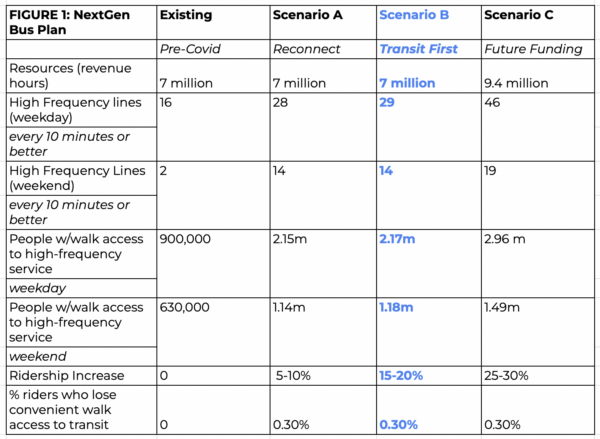
Without a more transparent budgeting and accounting process, the public isn’t able to help understand and shape the public dollars and infrastructure desperately needed by so many. At the bare minimum, Metro should be honestly sharing how much progress has made on implementing the NextGen Transit First Scenario (see Figure 1), which, according to the direction of the Metro Board, was scheduled to take place over 6 years and to include nearly $1 billion in capital spending and reallocated bus service hours to create an all-day, frequent, and reliable network.

The approach from Metro was: we shouldn’t add more buses until we fix the underlying infrastructure of the bus system.  Metro identified that infrastructure, which includes things like bus stops, shelters, and the congested city streets in need of bus only lanes, as being the primary contributing factor to declining bus speeds. Consequently, fixing the underlying infrastructure meant consolidating bus stops, creating new bus-only lanes, allowing passengers to board through rear doors, implementing traffic signal priority for buses, and improving the bus stops themselves. The plan also included the elimination of almost all of the system’s Rapid buses, including the Santa Monica Boulevard Line 704, Venice Boulevard Line 733, West LA to Sylmar Line 734, with the idea being that their service would be consolidated back into local routes that would be making fewer stops. 

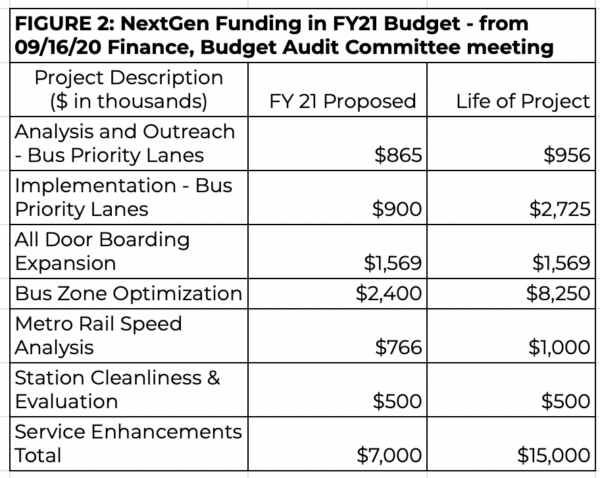
While the rapid routes were actually eliminated, it’s unclear if speed improvements have actually been realized since data and implementation information has been hard to come by. What we do know is that by the end of June 2021, at least $7 million was allocated to be invested in bus speed improvements (see Figure 2).

Questions still linger…how much of that was spent and where? What was programmed for the following year in FY22? Is $7 million a year the best Metro can do given the critical importance the bus system is for so many people in the Los Angeles Region who are struggling to get by? These are the essential workers and others who rely on the bus for their daily needs during the pandemic. (Metro had the least amount of transit ridership loss during the past two years than any other transportation agency in the Country.) 

Since 2018, the Metro and LADOT bus speed work group has implemented 12.8 bus only lane miles, which is small but important progress on a very large problem.

To put it in perspective, remember the scale of the bus and street network in Los Angeles: the City of Los Angeles alone has 23,000 lane miles, and about 40% of those are major avenues and boulevards.

In addition to creating Bus Only Lanes (BOL), the Metro and LADOT work group is:

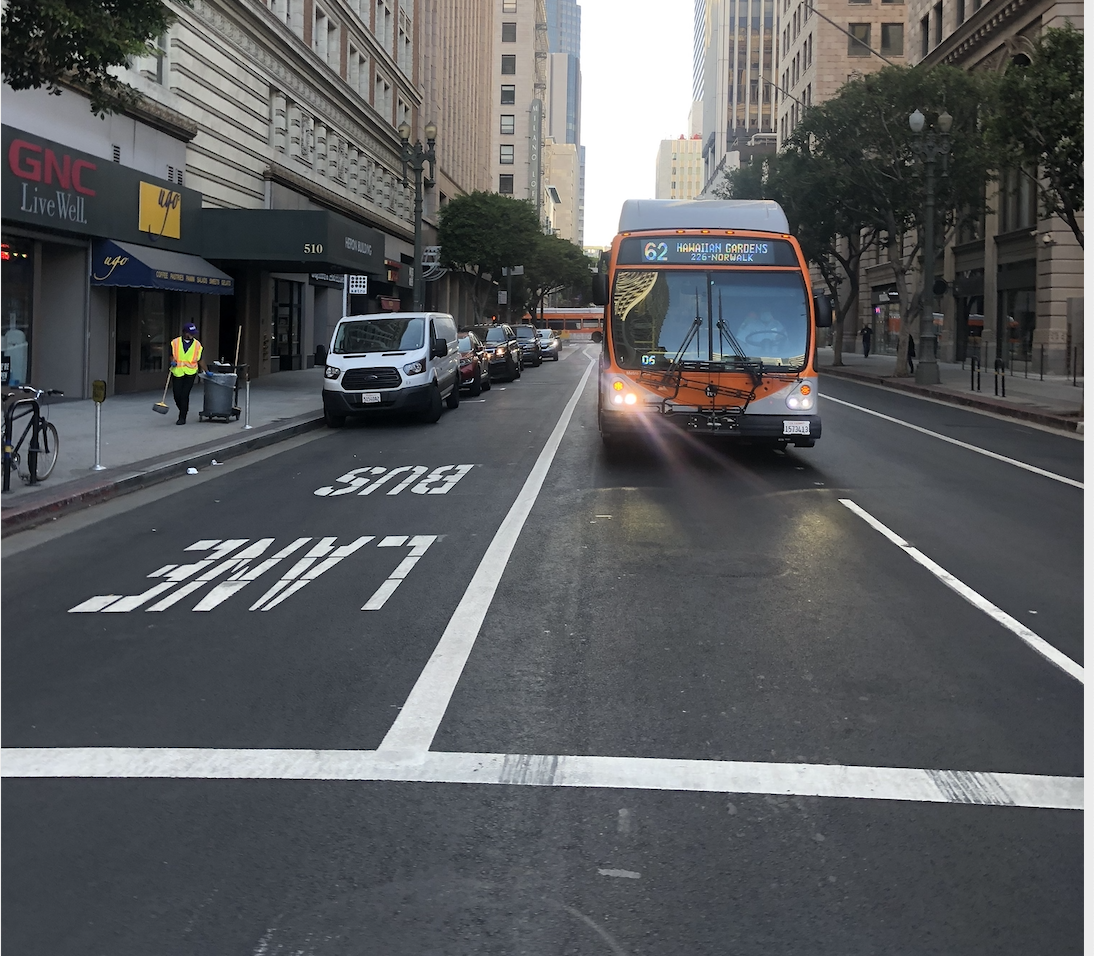
  • Piloting red paint/thermoplastic treatment –  In the summer of 2021 LADOT implemented this partial red thermoplastic treatment along portions of Wilshire Boulevard and the MyFigueroa segment in DTLA and has recently started applying it in and around downtown Los Angeles. 
  • Implementing their successful AB 917 State Legislation for Camera Bus Lane Enforcement.  LADOT has recently started to develop implementation strategies for this legislation. 
  • Implementing Metro G Line (Orange) Busway signal improvements.
  • And future work includes (per a Jan 2022 Board Report): “Metro continues to work with LADOT to improve editing Transit Signal Priority (TSP) and expand it to more buses and along non-TSP Tier 1 Corridors. Today on Metro Rapid Buses receive TSP, which can extend green lights to prioritize certain buses. Metro is exploring the viability to enable TSP on its entire 2,300 bus fleet.”

These are laudable projects. They also represent a welcome shift in the relationship between the City and Metro, which have often seemed to operate at cross purposes on the issue of bus service. But both the level of investment and the rate of progress are wholly incompatible with Los Angeles’s existing (let alone its forecasted) needs.

While COVID-19 has created trying and unprecedented conditions for many local government agencies, it has also presented tremendous opportunities to try new approaches. Federal COVID relief funds are ideal resources for the one-time fixes of many of the bus routes and services needed to improve operations and bus speeds. These investments would have a significant immediate and long lasting impact for the bus network. 

But has any of that happened? With available public data we have been able to find so far, it’s just not clear. 

Investing in Place has been attending NextGen Metro meetings since 2018. For years, we have written analysis, blog posts, comment letters, led convenings and work groups, collaborated with partners for organizing and advocacy with Metro Board members and at Board meetings, but now we find ourselves looking at data and conditions where Metro bus service is actually worse now than it was 25 years ago.

As we struggle to measure Metro’s adopted NextGen Plan, its stage of  implementation, and the state of Metro’s bus service – we keep coming back to Metro’s opaque budget and funding prioritization process. We are seeking to understand why there seems to be no funding to substantially improve the Metro bus experience. It’s a publicly stated priority, yet the proof that investments have been made are less so.


Categories
Uncategorized

The Metro Bus Operator Crisis

Being a bus operator is hard work. It is both physically and mentally demanding work, and throughout the long days, drivers are charged with getting riders to their destinations safely. Too often, it is a thankless position.

The COVID-19 pandemic, and the economic upheaval that has accompanied it, appears to have changed the calculus for many of those in Metro’s labor pool. Metro has been losing more operators each month than it can hire.

In the Fall of 2021, as Metro tried to reinstate pre-COVID bus service (7.1 million RSH), the agency’s statistics show a gap immediately between the number of worker-hours that Metro would have needed to run service according to the timetable and the worker-hours they actually had at their disposal.

The picture on the ground was grim. Riders were left stranded by the system as operator callouts led to rolling cancellations throughout the day. That was despite promises from Metro to undo the COVID service cuts and repeated admonitions from the Board of Directors to boost hiring to support the NextGen program that riders were told would finally boost frequencies on major corridors.

Like so much else in our region, the worst impacts of the service cancellations were concentrated in some of the neighborhoods that could least afford them. According to an analysis by Henry Fung, chair of Metro’s Community Advisory Council, canceled buses fell disproportionately in South Los Angeles. Out of 15 bus lines which reported a 25% or greater cancellation rate in January, Fung says that 13 of them serve South Los Angeles. And, that rate means that one out of every four buses on a line would be canceled every day for the entire month. The Vermont Rapid Line, one of the few Rapid lines remaining serving one of the county’s busiest transit corridors, experienced a cancellation rate of nearly four in 10 buses – 40%!

The reasons for such a disparity – and why it should fall on one of the poorest regions of Los Angeles County – might be able to be found in the way Metro schedules operators work. Fung indicates that after training, new operator hires at Metro may be sent to work anywhere in the county. Metro’s service area is enormous, and, with Los Angeles’s traffic, this can result in multi-hour commutes for drivers to or from work in an unfamiliar part of town. Municipal bus services throughout Los Angeles County such as Long Beach Transit and Santa Monica Big Blue Bus have much smaller service areas, which therefore ensures a greater idea for prospective bus operators where they will commute to.

The elevated number of operator callouts in South Los Angeles could be, at least in part, a product of harmful perceptions about the frequently stigmatized area. This is a challenging problem, to be sure – but it is Metro’s duty to solve it and solve it well. Riders in South Los Angeles rely on transit to navigate the city. Good transit can liberate riders, but on the flipside bad transit can entrap riders.

Investing in Place’s analysis indicates that despite the unfavorable commuting conditions and high cost of living, operators start at a rate ($19.12 after six months) that is below several of the agency’s peers. As Henry Fung writes in his letter, the approximately $30,000 a new hire at Metro could expect to earn in a year is barely enough to get by, even without the challenges that come with being a bus driver.

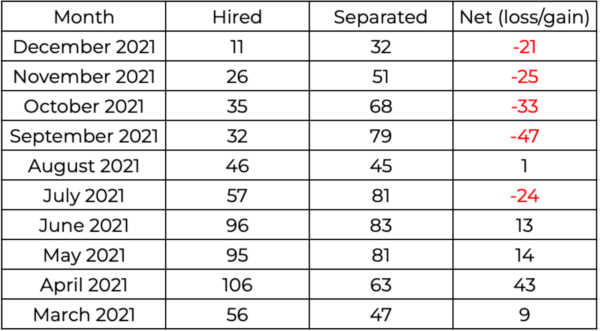
Metro is currently short almost 600 bus operators. This is a crisis.  Based on the data we have, the best month Metro had in hiring new operators was April 2021, with 43 new people hired, but they haven’t hit that level since. 

Metro Transit Operator Hiring Trends 

*Metro Rail and Bus Operators come from the same group of staff. When Metro increased rail service, it took away bus operators. And when new rail lines start, that will be another hit to the bus operator pool.

At this rate it may be years before Metro has enough operators to restore bus service to pre-COVID levels.  The impact of this is huge, we know that the majority of Metro bus riders have no other choice but the bus to meet their daily needs.  COVID-19 bus ridership numbers clearly demonstrated that.  Metro suffered the least amount of transit ridership loss than anywhere in the country since the start of the pandemic. Metro bus riders still relied on the bus in the early days of the pandemic. Why, you may ask? Because Metro is a lifeline, the only option, and likely because many bus riders are also low wage service workers who took care of the region while many of us sheltered in place.

The current contract with Metro’s transit operators expires June 30, 2022. Metro executives and Union leadership are meeting to develop a new contract.

We have learned about key themes impacting the desirability of the job such as: 

  • Starting Pay
  • Unpredictable schedule and location
  • Working conditions on the bus 
  • The fact operators are currently contractually required to show up  for overtime hours if called back. Over the past two years this has had a tremendous impact on staff and their families due to Metro’s operator shortage.

It is critical that all Metro leaders – Board and staff – recognize this crisis, and respond with significant changes to restructure the job and the working environment, analyze key takeaways that come up from current operators to inform changes to the new contract, and speed up and streamline the path to full time employment.  It is particularly important to get input from current bus operators – particularly ones with 1-3 years of service.  They can illuminate why so few people want to be a Metro Bus Operator.  

Every decision made by Metro leadership should consider this information to address this crisis if they want to make progress and improve from conditions within the next year. Metro and the Board need to respond with urgency and commitment to radically improve the bus experience for everyone.

Categories
Uncategorized

Metro bus operations: the past, present and future

Metro is currently running the same amount of bus service now as it was in 1998, nearly 25 years ago. Metro is running 6.2 million revenue service hours (RSH) after service cuts were implemented last month due to the bus operator shortage crisis.. We’ll repeat it again. Metro is running the same amount of bus service as it was in 1998. The biggest difference between now and 1998 is that Metro’s budget was only $2.8 billion dollars  compared to today’s $8 billion dollar budget. Metro’s budget has grown because of two additional voter-approved sales taxes (Measure R & Measure M), increased state funding, and federal funding. AND, Metro’s buses have gotten slower.

Bottom line: With a nearly tripled budget, Metro bus service is actually worse now than it was 25 years ago.

The solution is clear: policy-makers and analysts need to be clear with the public that they understand what they are sacrificing and who they are negatively impacting by NOT prioritizing the needs of millions of trips made by people who rely on our bus system for their survival. Investing in Place is currently analyzing over 25 years of Metro budgets and bus operations with a goal of curating data to increase a shared understanding of what has been going on. Our goal is to be able to produce the tools for policymakers, partners and interested community members to understand and engage with Metro’s operations spending.

But first, we have to understand the agency’s history on bus operations funding, where it is today, and analyze what we see is being allocated in the upcoming Fiscal Year 2023 budget. We anticipate the FY23 Transit Operations budget to be presented to the Metro Board in the next few weeks. 

Look out for our next post on the Metro Bus Operator Crisis.

Categories
Uncategorized

Spending Without a Plan

Los Angeles invests hundreds of millions of dollars each year in sidewalks, streets, trees, access ramps, bus stops, lighting, and other public infrastructure.

Yet Los Angeles remains the only major U.S. city without a comprehensive Capital Infrastructure Plan.

That matters because infrastructure decisions shape daily life. They determine whether sidewalks are accessible, bus stops are comfortable, streets are safe, and neighborhoods receive the investments they need.

The Government Finance Officers Association recommends that cities adopt multi-year capital plans to guide infrastructure investments, establish priorities, coordinate funding, and account for future maintenance needs. Most major cities already do this.

Los Angeles does not.

As a result, infrastructure investments are often managed across multiple departments, programs, and funding sources without a single public framework that connects priorities, projects, budgets, and outcomes.

This creates a fundamental challenge.

How much funding is available for infrastructure improvements?

What projects are being prioritized?

How are decisions being made?

How do investments align with the City’s goals for safety, equity, accessibility, and mobility?

And perhaps most importantly: How do we know whether we’re making progress?

In recent years, Los Angeles has dedicated hundreds of millions of local dollars to transportation and public works projects. Yet there is still no comprehensive, publicly accessible plan that shows where investments are being made, how priorities are established, or how decisions connect to broader city goals.

The issue is not a lack of funding.

The issue is a lack of coordination and long-term planning.

A Capital Infrastructure Plan would provide a framework for understanding infrastructure needs, establishing priorities, coordinating investments across departments, and improving transparency for policymakers and the public.

It would also help the City address a larger question:

What kind of public realm are we trying to build?

Before Los Angeles can make strategic decisions about infrastructure, it needs a shared vision and a clear understanding of the assets it manages, the investments required, and the outcomes it hopes to achieve.

This conversation is about more than budgets.

It is about whether Los Angeles can create a system that delivers safer streets, accessible sidewalks, healthier neighborhoods, and better public spaces over the long term.

The City has an opportunity to move in that direction.

But first, it needs a plan.

Categories
Uncategorized

Show us the money

The City of Los Angeles is developing a new bus shelter program as its long-standing street furniture contract comes to an end.

New shelter designs are important. But before discussing what shelters should look like, Los Angeles should answer several more fundamental questions.

How many bus stops need shelters?

What will the program cost?

Where will funding come from?

How quickly can shelters be installed?

Will sidewalk repairs and accessibility improvements be included?

How will bus stop investments be coordinated with shade, trees, and other public realm improvements?

These questions matter because bus shelters are not simply pieces of street furniture. They are part of a larger transportation and accessibility system.

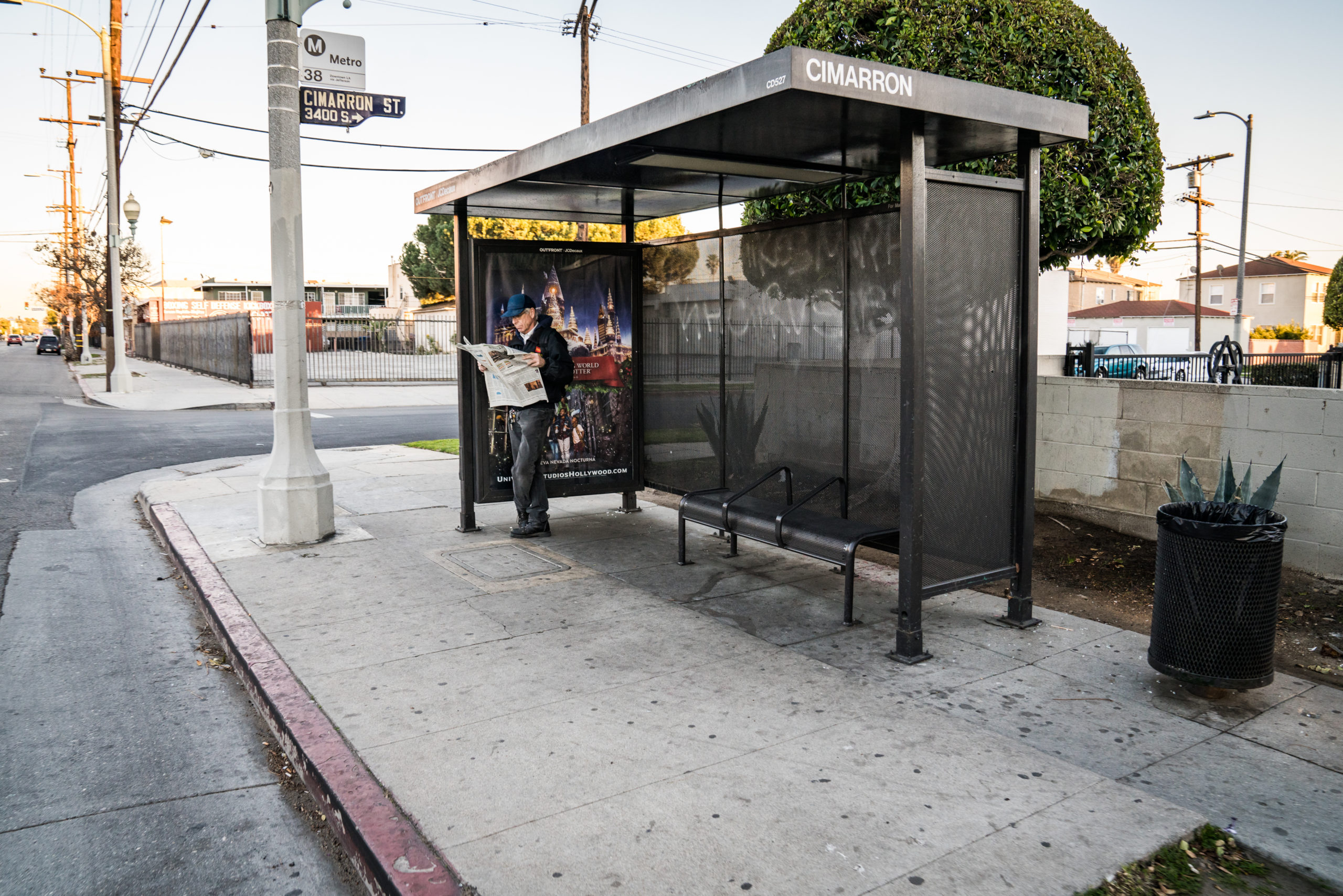
For decades, bus shelter investments in Los Angeles have largely been driven by advertising revenue rather than rider needs. The result is a system where some of the busiest transit stops lack basic amenities such as shade, seating, and accessible boarding areas.

At the same time, the City still lacks a comprehensive inventory of sidewalk conditions and bus stop accessibility, making it difficult to understand the true scope of the challenge.

As Los Angeles develops its next generation of bus shelters, the conversation should extend beyond design.

The City needs a clear funding strategy, an implementation plan, and a commitment to improving the sidewalks, access ramps, trees, and public spaces that support transit riders every day.

Bus riders deserve more than a shelter design competition.

They deserve a program that delivers results.

Categories
Uncategorized

What South LA Moms Told Us

Over the past year, the COVID-19 pandemic significantly affected how people moved around Los Angeles, particularly mothers in South Los Angeles. Public transportation became less frequent and more crowded, while long-standing infrastructure challenges—from cracked sidewalks to a lack of protected bike lanes—continued to make daily trips more difficult.

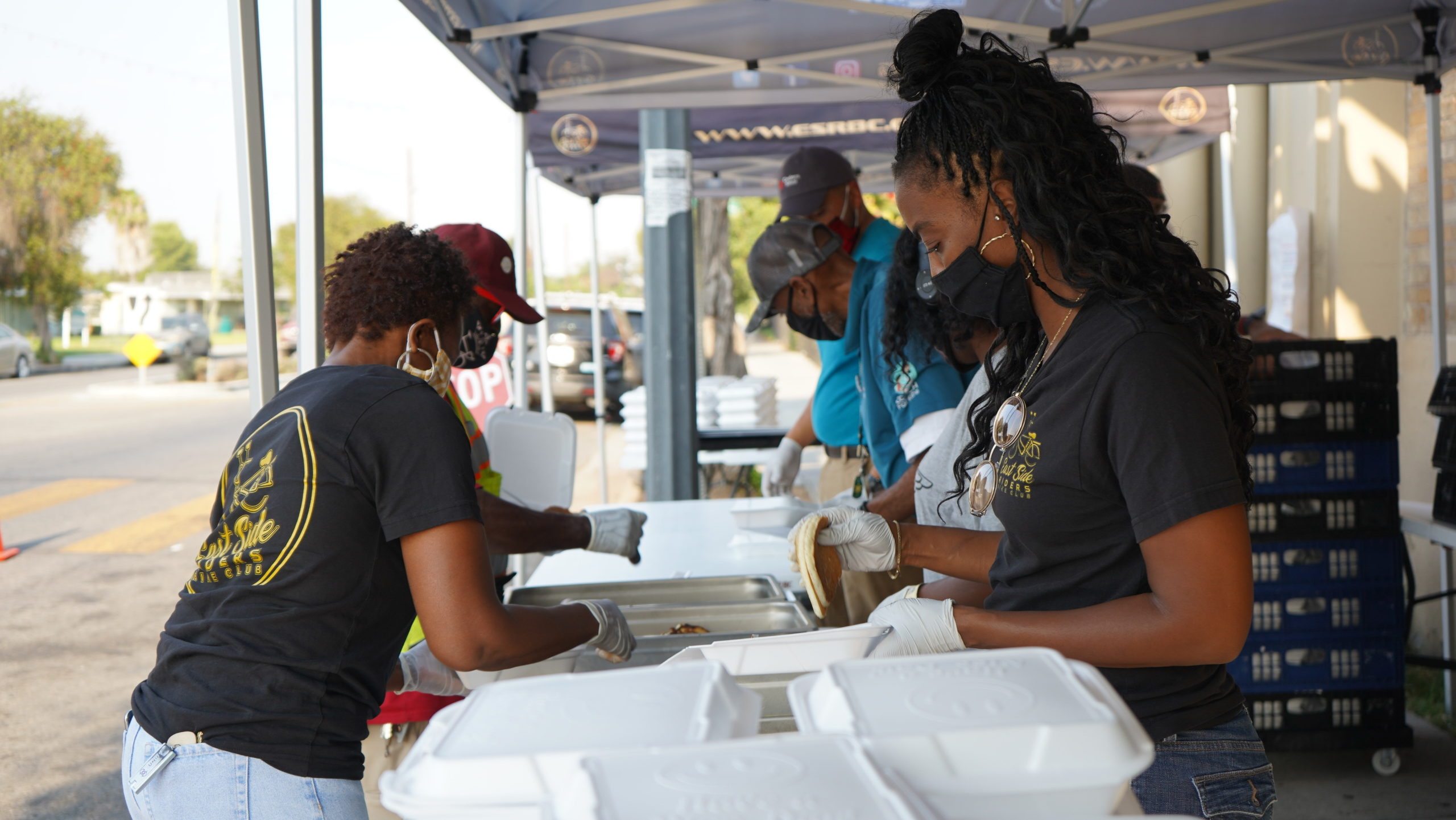
To better understand these experiences, our partner East Side Riders Bike Club surveyed 23 Black and Latina mothers between November 2020 and March 2021 about how COVID-19 affected their transportation needs. You can read the full survey results here.

East Side Riders Bike Club (ESRBC) is a community-based organization rooted in Watts that uses cycling, youth programming, food distribution, and community events to strengthen neighborhoods and improve quality of life. We are grateful for their partnership in this work.

What We Learned

Of the mothers surveyed:

  • 70% identified as Latina and 30% as Black.
  • 57% reported household incomes under $25,000 per year.
  • 74% were between the ages of 30 and 45.
  • 39% learned Spanish as their first language.

Cars Are Often Necessary—but Expensive

Eighty-three percent of respondents said a car was their primary mode of transportation. At the same time, 70% said they were not looking for or saving to purchase another vehicle, and 70% knew other mothers who struggled with the costs of car ownership, including insurance, maintenance, and fuel.

The findings suggest that while driving is often necessary, it can also be a significant financial burden.

Mothers Use Many Modes of Transportation

Most respondents drove for everyday trips such as school drop-offs, grocery shopping, and medical appointments.

However, recreation trips showed a different pattern. Mothers reported using trains, bicycles, and other transportation options for visits to parks, beaches, museums, and family gatherings. These responses suggest that many families may be open to using alternatives to driving when safe and convenient options are available.

Safety Was a Major Concern

When asked what improvements would most benefit their families, nearly half of respondents identified protected bike lanes and bike paths separated from traffic.

Many also wanted infrastructure improvements that would reduce dangerous driving and speeding. These concerns were reflected in responses about walking as well, with pedestrian safety emerging as a top priority.

For many families, transportation is not simply about getting from one place to another. It is about being able to move safely and comfortably through their neighborhoods.

Why It Matters

Transportation decisions affect daily life in profound ways—especially for parents navigating work, school, errands, healthcare appointments, and recreation.

These survey results remind us that investments in sidewalks, bike infrastructure, transit, and traffic safety are ultimately investments in people and families.

We are grateful to East Side Riders Bike Club for their partnership and for the incredible work they do in the community.

About Moms and Mobility

This survey was part of Investing in Place’s Moms and Mobility initiative, a partnership with East Side Riders Bike Club, Los Angeles Walks, and South Central LAMP. Together, we worked to elevate the experiences and priorities of women and mothers in transportation policy and investment discussions across Los Angeles.

Categories
Uncategorized

Why Metro’s Restored Bus Service Still Falls Short

Next week, Metro is set to vote on its largest ever annual budget. Spurred by the ongoing economic recovery in Los Angeles and stimulus support from the federal government, the transit agency expects to spend $8 billion next year. That money pays for rail and highway construction, system maintenance, local government services. But, as Metro points out, it will also go toward restoring transit service to its pre-Covid levels after the Board of Directors approved 20% cuts last year.

Joined by a coalition of transit riders, advocates, and community organizations, Investing in Place opposed the bone-deep service cuts put in place by Metro during the pandemic. These cuts, we argued, would fall disproportionately on the Black and brown low-income Angelenos that make up the core of Los Angeles’s transit riders. While local leaders spoke about the selflessness of essential workers, they were putting many of those same workers in even greater risk of lost wages, serious illness, or even death by stripping the transportation services on which they relied.

Metro argued that these cuts were undertaken out of necessity, but that was shown not to be the case when staff identified a mid-year surplus and failed to recommend that any of that money be used for restoring service. When the Board of Directors twice directed the agency to use the additional funds to boost bus service, staff delayed and an eventual compromise was put in place to return to the pre-Covid level of service by September 2021, a full 18 months after the cuts were first implemented.

In pushing Metro to provide the “Old Normal” of service during the pandemic, we were asking the agency to hold the line in support of the riding public. This, in our opinion, was a duty that Metro owed to Angelenos who had no choice but to continue relying on public transportation. Now, though, with Metro’s financial position better than ever, we cannot support the idea that the Old Normal is cause for celebration.

Since the end of a federal consent decree in 2006, Metro has repeatedly cut bus service. With the exception of the cuts that began in March 2020, bus service has been kept flat for nearly a decade. During that decade, riders voted with their feet, abandoning the buses and the transit system as a whole once it became clear to them that Metro was not serious about providing high-quality service.

Riders can tell from experience when transit service is bad. The wait for buses becomes agonizing. The time it takes to get to their destination becomes unreasonably long. But they generally don’t have data on hand to make their experience something more than anecdotal. It turns out, Metro’s own budgets show the degradation in service that riders have been noticing on the ground.

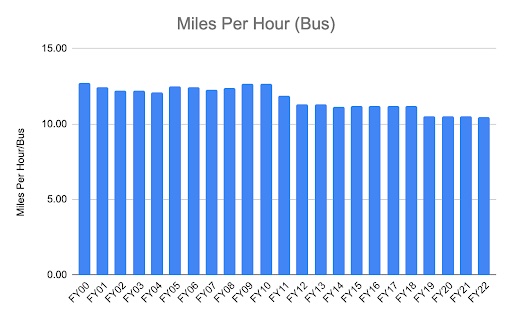
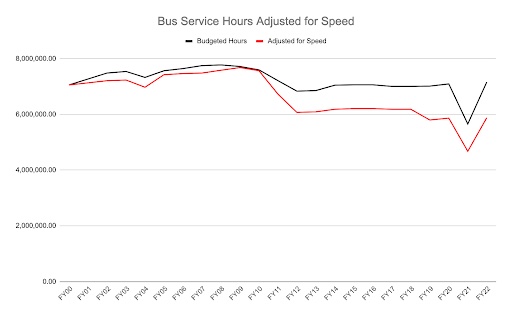
In statistics that the agency records on the number of hours its bus fleet is in service annually, as well as how far they cumulatively travel each year, it can be seen that bus speeds have dropped 20% on average since the start of the 21st century.

In the upcoming budget year, Metro expects that bus speeds will reach their lowest point yet. And, as NextGen redirects more bus service hours onto congested corridors where demand is higher, we can expect that trend to continue without significant and expedient work to get buses moving faster. That means that, even as Metro touts its belated decision to return to the pre-pandemic Old Normal, the actual amount of bus service riders are getting will continue to decline.

Below, we graph the number of budgeted service hours for each year dating back to 2000 in black. But, if we want our year-to-year comparisons to be more effective, we want to adjust each years budgeted hours based on average bus speeds. That is shown in red. What the red line tells us is, for any given year, how much service would need to be provided in order to match what riders could have expected at the start of the century.

Our takeaway is simply this: bus service has collapsed since the Great Recession, and Metro has done nothing to repair it. More and more transit riders have left the system because of the too-slow, unreliable, infrequent, and unsafe riding environment that Metro provides. While the agency says they are “restoring” service, the real service provided continues to sink. And riders cannot be fooled.

If Metro were to provide a level of bus service equal to what was provided in 2000, it would need to dramatically accelerate its bus fleet or provide 1.5 million service hours above what is currently proposed in the 2022 budget. While the NextGen plan proposes to accelerate buses, on the current funding timeline, it would take a decades or longer to complete the planned speed improvements to the network. This budget is, quite frankly, not a document that reflects either the ambition or the urgency with which Metro needs to approach the problem of declining bus service.

We call on Metro to dramatically increase the level of service provided in the 2022 budget, and to begin the first real expansion of bus service in Los Angeles since the end of the federal consent decree.

Categories
Uncategorized

How Much Funding Does Metro Have for Transit Operations and Building Back Buses Better?

A few months ago, during a presentation on Metro’s latest initiative intended to rescue the failing bus system, a proposal was floated to request $100 million in federal funding for the purpose of improving the region’s long neglected bus stops. Investing in Place has long called for shelters and other components of a safe and dignified riding experience, so it is encouraging to see Metro begin to direct its focus in this area. But it is concerning to hear that this investment is being held out as contingent on federal aid, when Metro has local resources for these purposes.


Improving the bus system is an issue of paramount importance for Metro. While major rail investments will take decades to pay off, the only thing standing between Los Angeles and a world-class bus network is that that has never been a high-priority goal for local decision-makers. Unfortunately, that also seems to explain why existing funds are not being targeted for these improvements, but it is extremely difficult to figure out what is being funded instead.


Understanding where operations-eligible money is going is critical to informing efforts to restore and expand bus service and bus only lanes beyond the pre-Covid baseline, as well as increase shade and bus shelters, reimagine public safety and support fare free transit. In advance of May’s public budget hearing, Metro should commit to providing a clear analysis of revenues eligible for transit operations, and whether funding for operations is being diverted to other projects.


Metro has significant funding from four sales taxes passed by county residents. However, the opacity of budgeting at Metro means that there is no easy way to hold decision-makers accountable to pursuing policies that would make life better for riders.


It is critical that not only advocates and community organizers, but also the Metro Board of Directors, understand whether operations-eligible money is going to support capital projects unrelated to transit operations (such capital expansion). These commitments will provide an irreplaceable boost to the equity of Metro’s budget process, by increasing the ability of community members and organizations to provide informed comment and analysis on agency budget and priorities. And have the potential to lead to seeing Metro develop a 3-5 year funding plan to build buses back better. 


We know we are not alone in the dark about understanding how Metro spends their discretionary funding. Operations funding covers many departments with Metro, including going to the agency’s policing contracts. We need Metro to provide transparency regarding how the different pots of money are being spent so that the public can determine whether those choices will achieve the key outcomes for the region. Metro is largely funded by the people of Los Angeles County – who have voted to tax themselves to provide more transit.


Last month, Investing in Place sent a letter to Los Angeles Metro requesting that the agency approach future budgets through a procedural equity lens. Procedural equity is a tool in which Metro’s organizational structures and policies would be transformed to better serve the marginalized communities Metro provides services to by making it easier for those communities to access and substantially impact Metro’s decision making process. We ask Metro to provide a clear analysis of revenues eligible for transit operations and other spending categories with clear descriptions and activities included in each category.

Categories
Uncategorized

Metro’s Budget Process Keeps Transit Riders on the Sideline

In May, Metro will vote on the approval for its 2022 budget, following a year of Covid-induced financial stresses. The vote marks a return to normalcy for Metro after the 2021 budget vote was delayed for months in the wake of the pandemic declaration and the accompanying economic shutdown. But for transit riders in Los Angeles, a return to the pre-pandemic normal is not a welcome prospect. 


Under the old normal, transit ridership plummeted deliriously as riders abandoned a service made unreliable through cuts and disinvestment. It saw the needs of a privileged minority of “choice” riders pitted against those of a stable base of bus riders, with the latter’s needs routinely being disregarded.


Things have been going wrong at Metro for far longer than the world has been in quarantine, and the blame for that can be traced directly back to the financial decisions baked into Metro’s annual budget process. As the primary transportation provider and planner for Los Angeles County, Metro’s budget accounts for more than $6 billion in annual spending on transit, highways, roads, and more. But the process by which that money is divvied up is decidedly old school: it’s a black box from which numbers emerge apparently at random with no explanation and next-to-no input from riders.


That’s why Investing in Place sent Metro a letter last month requesting that the agency begin to change the way it approaches budgeting to address procedural equity concerns. Procedural equity can be thought of as the way in which a service provider centers the needs of those most affected by its policies in its internal structures. Are there organizational structures and policies that support access to spaces where decisions are made? Are groups who face greater barriers to accessing service proactively sought out so they can authentically engage with decision-makers? Can they really expect to influence how decisions are made?


In Metro’s case, Investing in Place believes the answer to each question is “No.” While, truthfully, much of the change will require a major shift in organizational thinking within Metro – a shift that we are hopeful incoming CEO Stephanie Wiggins will help to bring about – there are small improvements that Metro could make without delay.


In particular, one proposal that Investing in Place submitted to Metro was that the agency should commit to extending the public review period for the budget from two weeks to a full month. The current 14-day window forces riders, activists, and organizers to compress a great deal of activity into an arbitrarily truncated timeframe. There is insufficient time to analyze the contents of the budget, conduct community outreach, and to collaboratively develop a response to Metro’s proposal. And, given that drafts of the budget are already available, it does not seem to be a hardship to suggest that they be shared publicly. Nonetheless, Metro has indicated that they will proceed with the 14-day timeframe for at least another year.


On our part, this ask was not for a silver bullet or panacea. We were asking for a show of good faith. A modest adjustment to the baseline that would demonstrate Metro’s commitment to making more lasting improvements to procedural equity going forward.


The role of transit advocacy groups like Investing in Place is to provide a source of analysis that can help build capacity and spread awareness in transit-riding communities. These are functions that Metro can and should be interested in fulfilling itself, but at a minimum it is in the agency’s best interest to support an informed and engaged ridership. It is our sincere hope that Metro will come around to viewing the development of its budget as a participatory process, and one of the region’s greatest tools for achieving equity.

Categories
Uncategorized

Metro (Again) Orders Bus Service Increases, Seeks to Regroup on Police Overruns

During the February meeting of the Metro Board of Directors, the transit agency was scheduled to hear two items with urgent importance to riders throughout Los Angeles: a plan from staff to restore service that was cut in September, and a request from staff for $111 million to patch enormous budget overruns for policing.

Transit advocates and community members have been pushing Metro to be more active in support of their riders, and that language has recently become a fixture within Metro’s Board meetings. In January, Directors indicated that they knew riders did not trust their needs to be met by their transit agency. Building that trust required listening and taking action based on what they heard, which the Directors sought to do in directing staff to restore bus service to pre-Covid levels by June of this year.

Operations staff returned in February with a report that said that bus service could not be restored before December, and that riders may be “confused” by the impacts of adding back cut service. Further, at the meeting of the Board of Directors, Metro staff again indicated that a building back of bus service hours was at cross-purposes with an implementation plan for NextGen that had been in place for years.

Even amidst the clear opposition from the Board, staff expressed yet more consternation about restoring service. Whereas riders and advocates have said for years that, even before Covid, successive cuts have left unacceptably infrequent service on Los Angeles streets, Metro is seeking to use ridership numbers as a reason not to provide more buses.

The frustration with these reports was evident in remarks made by the Directors. Board Chair Eric Garcetti expressed his disappointment that Metro’s service restoration plan would take so long, and that the report received was so focused on reasons why trying to serve riders better and faster might not pan out. In introducing the presentation by Operations head Jim Gallagher, Garcetti warned that he would be listening for solutions-oriented language: “I’m less interested in why we can’t do it.”

Directors Mike Bonin and Janice Hahn spoke with similar force about the pressing need to stand with the predominantly low-income, disproportionately Black and Brown riders that rely on Los Angeles’s buses. Director Bonin stated that this was now the third time that the Board would be giving the same directive to staff, and that staff had apparently thought the Board “didn’t mean it.” Directors Solis, Hahn and Garcetti each made suggestions about potential pathways to accelerating a return to pre-Covid levels of service.

As riders and advocates have become increasingly vocal about the impacts of service cuts during the pandemic, the Board has shown that they are listening. That can be seen, too, in what was not discussed during February’s meeting. 

Originally scheduled to be approved, an item that would have approved $111 million in funds for Metro’s policing contracts was suddenly removed from the agenda at the last minute. This huge sum of money needs Board approval because over the last three years, Metro has already spent it. To date, the agency has spent about 15% in excess of the $750 million baseline contract approved by the agency in 2017.

It is hard to imagine any other category of spending in which budget overruns like this could be racked up over a period of years without, apparently, any authorization by the Board. Further, advocates and riders continue to press Metro to change what public safety looks like on the system in a fundamental way.

Metro’s relationship with police is under widespread scrutiny, like many other public agencies in Los Angeles. While the county, LAUSD, and voters themselves have sought to pursue new models of public safety, Metro has mostly continued under the status quo.

Metro’s policing overspending item will return for consideration by the Board in March, and there is a requirement that riders and advocates will continue to place on Metro’s Board of Directors: that they give consideration to the needs of all their riders. Black riders, brown riders, unhoused riders. They, as much as white so-called “choice” transit riders, deserve to feel safe, and deserve to feel that their needs are a priority to Metro.


Categories
Uncategorized

Metro Overspent Its Policing Budget By How Much?!

On Thursday, Metro’s Board of Directors will be asked to vote on floating more than $110 million in additional funding to maintain the agency’s existing contract for uniformed police on the transit system. The contract, which was negotiated in 2017, resulted in replacing the Sheriff’s Department with a lucrative policing-by-committee approach including sheriff’s deputies and officers from the Los Angeles and Long Beach Police Departments.

Concerns were raised back then about the terms of the agreement. In particular, its planned expenditures of more than $650 million over a five-year period offered a potentially huge new revenue stream for both the LAPD and the LBPD. The contract consisted of offering overtime to officers – specifically to more expensive supervisory staff –  was enough to make the public wonder how much we were truly getting for our money. The response was that the overtime pay was a useful tool to make the shifts more attractive as voluntary work. 

There were also plenty of concerns about the reputation of these agencies over policing Black and brown Angelenos, and Metro’s history of targeting these same riders for violations of its code of conduct. Those questions only became amplified last year in the wake of the killings of Breonna Taylor, George Floyd, Dijon Kizzee, Andres Guardado and too many others by police.

So what is happening in Los Angeles? Last week, Metro staff gave a presentation to the Operations and Public Safety committee stating that through the first three years of the five year contract, the agency has overspent its budget for policing by about 17%–that’s $111 million dollars! The policing contract includes no money for special event deployments or other times that Metro might request a police presence on the system.

According to the staff presentation, without the Board’s approval to boost the total contract value to up near $800 million dollars, the agency will run out of money for policing by this summer – a full year early. Staff compound this by saying they also expect to return to ask for an extension of 6 months on the existing contract, amounting to $84 million more dollars (plus whatever unvetted additional services staff authorize, of course).

Let’s not mince words. Metro has to ask for an increase in its contracts with the Los Angeles Police Department, the Long Beach Police Department and the County Sheriff because the original contracts were egregiously generous and because the agency’s approach to policing  mirrors the systemic failures we’ve seen elsewhere; namely, overly generous contracts with little oversight, insufficient accountability mechanisms, and an over-reliance on police overtime.

There is no other category of spending that could exceed its budget by this much without the Metro Board raising serious questions about the program’s sheer fiscal irresponsibility. As we have discussed at length with respect to bus service, even when the Board directs money to restoring service, Operations resists spending it. How is it then that in the wake of the largest wave of calls to change the mainstream conception of acceptable policing practices, Metro is pushing not only for more money but for a longer period of time on a contract that simply is not working?

We find ourselves asking the peculiar question of having to ask, “Did Metro not know that special events happen in Los Angeles?” Given the intensity of focus at the same time as the contract was approved on the recent selection of the city for the 2028 Olympics, this seems unlikely. What was the chain of approval for requesting special police deployments? Why is Metro only coming to the Board for approval after multiple years of above-budget spending?

There are so many questions that the Board should put to staff, but the biggest one is this: Why should the Board – or the public – trust Metro’s spending going forward? In a moment when radical change is being demanded, staff has indicated that they are dedicated to retrenchment – failed models of policing that rely on pushing armed police into confrontations with unhoused Angelenos.

Metro owes the public a full accounting of what went wrong with this contract. Why was the contract structured in a way that allowed the agency to run up a huge tab for unanticipated services? What alternatives did the agency consider when existing policing resources were deemed insufficient? How is the agency holding leadership accountable for contract overages and what controls are being put in place to ensure that this doesn’t happen again? As the agency is convening an Public Safety Advisory Committee that will be providing recommendations for a future public safety contract, we need to have a clear understanding of what went wrong here. Expanding an already bloated police budget at a time when the public, including Investing in Place and many partners we work with, are calling for more thoughtful and effective approaches to public safety does not inspire trust.

Riders want, expect, and deserve a safe riding experience, but we do not accept that the current contract and approach delivers that. The Board should take notes from the Los Angeles Unified School District and use this as an opportunity to be bold in redirecting funds from policing to other resources to provide compassionate public safety and services on board the system.  It is past time to close the door on this failed contract and the attitudes toward policing that it represents.

Investing in Place is working towards a vision where Los Angeles is a city that addresses the safety and access needs of all who call it home. We stand in solidarity with our partners like the Labor Strategy Center/Bus Riders Union and Alliance for Community Transit – Los Angeles, who have been advocating for years to reimagine public safety on our public transit system and divest to invest in our communities. Not only is this contract broken, but so is Metro’s approach to its role in supporting public safety for Black and brown people as they travel throughout our region, and now is the time to revisit that approach. 


Categories
Uncategorized

Metro Rejects Board Directive to Urgently Restore Bus Service For Essential Workers

During February’s meetings of the Metro Board of Directors, agency staff is preparing to deliver a recommended plan for restoring service that once again rejects a clear directive from the Board to “immediately” begin restoring bus service to pre-Covid levels.

Instead of following through on this promising turn of events, staff have produced a report full of excuses and obstructions, ultimately concluding that the pre-Covid baseline of 7 million annual bus service hours should not be returned to before the end of 2021.

While the Board acknowledged that it would take time to recruit and hire staff sufficient to resume pre-Covid bus service, staff present it as an insurmountable challenge. According to the new report, they can neither hire, train, nor even process the number of resumés that would be required to get more drivers on the road. 

We view this excuse as unacceptable. Bus service is Metro’s business and these are extraordinary times. Metro riders have faced greater challenges than this every single day of the pandemic.

Perhaps most frustratingly, Metro staff seems determined to cast the NextGen plan to improve the lacking quality of service on LA’s buses as directly oppositional to increasing the frequency of buses on the road. NextGen was not adopted with the immense service cuts that were undertaken in the wake of the Covid pandemic in mind. Nor were those cuts part of an intended transition plan. Now that the cuts have been adopted, however, Metro claims that reversing the cuts would be “confusing” for riders.

It is important to remember how we got here. Bus riders, transit advocates, and the Board of Directors themselves had to rally to course correct decisions by agency staff that failed to consider the needs of riders. 

In the January meeting of the Board of Directors, Metro staff proposed to allocate zero dollars out of an enormous unexpected surplus of sales tax revenue to restore the bone-deep service cuts that the Board had approved in the fall of 2020. The Board’s response to staff’s failure to prioritize riders was categorical.

Director Bonin said, “There is not a greater need than to begin to restore service.” He added that the failure to restore service for workers during the pandemic was a failure to meet “the demand of the moment.”

Director Hahn took Metro staff to task for having failed “to address one of the Board’s biggest priorities: restoring service.” She further highlighted the fact that bus riders are essential workers and that not just Metro but the entire region relies on bus riders. “Their work and dedication,” she said, is what has kept Los Angeles’s economy running smoothly, and not without cost to the workers personally. Hahn concluded, “Our riders need to be able to depend on us.”

Directors Dupont-Walker, Garcia, and Solis concurred on the intensity of need in low-income Black and brown communities during the pandemic, with Garcia adding that Metro has heard “time and again from riders” that frequent service needs to be prioritized.

Throughout that meeting, discussion returned to equity, which Metro has said is to be a primary focus for the agency moving forward. Directors noted repeatedly that the focus on equity must begin with increasing service.

Despite receiving numerous calls from members of the public about the direct impacts that service cuts during the pandemic were having on the lives of real people, staff has rejected calls for immediate relief for passengers. In the report, reference is made to postponing service increases until a full vaccine rollout has been achieved. Definitionally, this means Metro is refusing to consider resumption of pre-Covid service levels until the pandemic is at its end. This contradiction of the orders of the Board should not be allowed to stand. To read the excuses contained within this report is to be overwhelmed by the sense that Metro staff simply do not want to do what it takes to improve conditions for riders.

We hope that the Board will stand by its righteous rhetoric from January and reject the plan set forth by staff to delay restoration of service.


Categories
Uncategorized

Listening to Moms in South LA

COVID-19 changed daily life for everyone, but its impacts were especially severe for many lower-income families in South Los Angeles.

In late 2020, our partners at South Central LAMP surveyed 36 Latina and Indigenous mothers from Mexico and Central America about how the pandemic was affecting their transportation needs. The survey offered a glimpse into the challenges families faced as they balanced work, childcare, healthcare, and essential errands during a time of unprecedented uncertainty.

You can read the full survey results here.

The Importance of Listening

One of the most valuable lessons from this project was not simply what we learned, but how we learned it.

Conducting these surveys required trust, time, and relationships. South Central LAMP staff met one-on-one with mothers, often through lengthy phone conversations that provided space for participants to share not only their transportation experiences, but also the broader challenges their families were facing during the pandemic.

Many mothers participated because they wanted their concerns to be heard. These conversations reminded us that meaningful community engagement takes time and depends on trusted relationships that organizations like South Central LAMP have spent years building.

What We Learned

Bus Service Matters

Sixty-one percent of mothers surveyed said they wanted more frequent bus service and shorter wait times.

For many families, transit remained an essential lifeline throughout the pandemic.

Driving Is Not an Option for Everyone

Nearly half of respondents did not drive, and two-thirds said they were not looking to buy or save for a car.

Some mothers shared that they did not drive because of financial constraints. Others described concerns related to documentation status or reliance on another household member to drive.

These findings highlight how important reliable transportation options remain for many families.

Safety and Neighborhood Conditions Matter

When asked what improvements would benefit their communities, mothers identified several priorities:

  • Cleaner streets
  • More street lighting
  • Reduced speeding and dangerous driving
  • Safer walking environments

These responses reflected a desire for neighborhoods that feel safe, comfortable, and welcoming for families.

Interest in New Transportation Options

The survey also revealed strong interest in car-sharing programs that could provide occasional access to a vehicle without the full costs of ownership.

For many families, flexible transportation options could help bridge gaps where transit service is limited.

Why It Matters

Transportation is about more than getting from one place to another.

It affects access to jobs, healthcare, childcare, education, food, and family connections. The experiences shared through this survey remind us that transportation decisions shape daily life, especially for families with limited resources and limited transportation choices.

We are grateful to South Central LAMP for their partnership and for the work they do every day to support families in South Los Angeles.

About Moms and Mobility

This survey was part of Investing in Place’s Moms and Mobility initiative, a partnership with South Central LAMP, East Side Riders Bike Club, and Los Angeles Walks. Together, we worked to elevate the voices and experiences of women and mothers in conversations about transportation policy and investment in Los Angeles.

Categories
Uncategorized

Response to today’s Motion: Restoring Bus Service

As detailed on the Investing in Place blog earlier this week, when Metro’s Board of Directors gathered on Thursday for its monthly meeting to allocate an unexpected windfall of sales tax revenue, the most likely outcome was that none of the new funding would go toward increasing bus service. Despite direction from the Board in September that staff prioritize a rapid restoration of service that was cut due to covid, internal recommendations called for that money to go towards maintenance and infrastructure projects instead.

But thanks to a coalition of Angelenos throughout the county and the leadership of a key group of Metro directors who showed their willingness to listen, learn and take action, this disastrous outcome has been avoided. Directors Garcetti, Bonin, Hahn, Solis, and Garcia have our appreciation for authoring a motion to correct the recommendations from staff that failed to prioritize Black and brown workers that continue to rely on Metro service. The motion they produced forcefully reiterated the prior stance of the Board that it is unacceptable for Metro’s service cuts to be maintained any longer than is absolutely necessary. The motion also directed staff:

  • To immediately restore a minimum of $24 million to transit operations;
  • To fund maintenance using capital funds instead of money eligible for bus operations;
  • To plan for restored operations at the pre-Covid baseline beginning in July;
  • To prioritize bus drivers for the Covid vaccine; and,
  • To identify opportunities to help all Angelenos get to vaccination sites.

This motion, overturning the recommendation of Metro staff, passed with a unanimous vote from the Board of Directors.

We say again, thank you to the Board of Directors for listening and for using their power to uplift transit riders. As Director Bonin said, this is only a first step, but it is a step in the right direction for transit riders in Los Angeles.

Most importantly, thank you to all the incredible transit riders and advocates that came together to pressure Metro to do the right thing. A diverse coalition that includes ACT-LA, the Bus Riders Union, Streets For All, the Democratic Socialists of America Los Angeles, SAJE, the Sunrise Movement, the Sierra Club, Cal State LA, and many many more came together and share in today’s victory. 

Without your support – your emails, calls and messages on social media – riders would likely have gotten no service back. Essential workers, Black and brown Angelenos from communities being slammed by the second wave of the Covid pandemic, would have continued to have to deal with unacceptably crowded and infrequent service.

This no small victory. For working class families, like those whose stories were shared with the Board today, restoring bus service is a matter of urgent importance. Each hour of service cut results in riders missing pay because they are late, or squeezed in close quarters that might result in themselves or a loved one contracting a deadly illness. As caller after caller testified, the workers that have kept Los Angeles moving during the pandemic rely on Metro. It is critical that we do whatever we can to protect them.

Today is not the end of this fight, but the beginning. Metro’s budget negotiations for 2022 are an even bigger battle that has already begun. In 2022, we will need to come together to push for continued service restorations and expansions of service above and beyond the pre-Covid baseline, while also halting the extension of huge policing contracts and freeway expansion projects that destroy communities.

But because of the watchfulness and responsiveness of Angelenos, we go into these conversations with momentum and, at least on this issue, with a majority of the Metro Board on our side. Thank you all so much, and let’s keep moving forward together.

Join advocates on Tuesday February 2nd at 11am, to debrief on Metro’s decision and discuss what comes next. RSVP here.

We  did this! Thank you to everyone who help submit over 150! written comments led by organizations and leaders at:

  • Action Center on Race and the Economy
  • Active SGV
  • Alliance for Community Transit-Los Angeles
  • Bus Riders Union
  • Cal State LA
  • Central City Association
  • Communities Actively Living Independent & Free
  • Community Power Collective
  • CSUN students
  • Culver City Council member, Yasmine-Imani McMorrin
  • Democratic Socialists of America, Los Angeles
  • Esperanza Community Housing Corporation
  • Ground Game LA
  • Institute for Transportation and Development Policy
  • Investing in Place
  • Jobs to Move America
  • Kenny Uong
  • KIWA
  • LA  Podcast
  • Los Angeles Forward
  • Los Angeles River Communities for Environmental Equity
  • Los Angeles Walks
  • Move LA
  • Natural Resources Defense Council
  • Neighborhood Councils in the City of Los Angeles
  • People for Mobility Justice
  • SAJE
  • Streets for All
  • Streetsblog LA
  • Sunrise Movement Los Angeles
  • Transportation Committee, Angeles Sierra Club
  • Transportation Committee, League of Women Voters of Los Angeles
  • UCLA students
  • UNITE HERE Local 11
Categories
Uncategorized

Metro to maintain service cuts despite $300M sales tax windfall

In what might be properly called a bonanza, Metro’s Board of Directors will hear a report on Thursday informing them that the agency is on pace to receive sales tax revenues nearly $300 million above what they had budgeted back in September. As the largest U.S. transit agency west of the Mississippi River, one might think such news would be welcomed within Metro as an opportunity to provide relief to the hundreds of thousands of bus riders who have had no choice but to bear with the agency as it slashed service in the face of fiscal uncertainty. So how is it possible that instead the likeliest course of action seems to be that the Board will approve a staff recommendation that restores none of the eliminated service – and even that unscheduled additional service cancelations will continue to be the norm?

Well, let’s back up. Local governments across the county, state and country are struggling mightily. Without the immense power afforded to the federal government to literally print money, or (generally speaking) even that of the federal and state governments to levy taxes on personal income, cities have been put in an extremely dire situation. The City of Los Angeles, for one example close to home, has approved massive worker furloughs and will potentially follow those up with layoffs in order to stitch up a $600 million hole in an already reduced budget. So Metro’s windfall is noteworthy and, frankly, strange.

Metro is in this fortunate position for three reasons. One is that sales tax revenue has been less affected by the Covid downturn than originally imagined. Characteristic of the extreme inequity that has suffused this unusual recession, entire segments of the population have found their ability to buy goods unchanged by the pandemic. A robust ecosystem of delivery services and online shopping – not to mention the malls, which as of this writing remain open – have enabled consumer spending to remain vigorous over the last year.

That leads us to the second reason: Metro is uniquely dependent on sales taxes. Locally generated sales taxes make up more than half of the agency’s annual budget. Compare that to the struggling City of Los Angeles, where sales tax accounts for 8% of the $7 billion general fund and even less overall.

And lastly there is this: A majority of Metro’s revenue comes from sales taxes because Angelenos have democratically elected – four separate times! – to tax itself to fund the agency. All public offices belong to the people, but, truly, none more than Metro. The very financial solvency of the transit operator is owing to a public that has affirmed and reaffirmed that transit should be a priority.

It is for these reasons above all that Metro now finds it has $282 million to allocate that it had not been expecting. But, surprisingly, increasing service from the bone-deep cuts approved in September does not appear to be a priority for staff. In fact, despite claiming that $59 million of the surplus would go to “Bus/Rail Operations and State of Good Repair,” none of the money is recommended for increasing service in a presentation put together by staff. Instead, the recommendation has it going to maintenance, infrastructure, and recruitment.

When Metro’s Board of Directors approved service cuts as part of its 2021 budget last September, they also approved a motion calling for ongoing staff reports on how the agency could get back to its pre-pandemic baseline. That motion stated plainly: “maintaining [the service cuts] for the remainder of the fiscal year is not acceptable for riders nor is it consistent with the agency’s strategic priorities.” But, despite this clear direction, staff have come back with a recommendation that flies in the face of the wishes of the Board and the riding public.

Staff provides little in the way of acceptable support for this recommendation. In an informational report, staff indicates that the economic recovery has stalled out and that ridership is trending down, despite 400,000 trips still occurring each day on the bus system alone. They also suggest that stricter stay at home measures have led to more individuals forgoing transit trips, but they neglect to mention that the same increased severity in the pandemic has also increased the need to protect the many riders who do not have that choice.

Perhaps most troublingly, staff have ruled out the expenditure of nearly all of the surplus sales tax $223 million of it as untouchable for the purposes of increasing transit service. This is because the money is instead going to offset lost revenues from fare sales (since most bus riders are riding for free still), advertisers, tolls, and parking. We will set aside for another post that Metro claims to be seeking to move to fare free service, and that this reluctance to fund service without farebox recovery portends very negative things for free service. Rather, most telling is the advertising revenue.

The staff report indicates that Metro’s ad revenue is down because its “advertising contract has been temporarily modified to provide relief to the vendor by reducing their payments.” The relief that the agency is refusing to riders it is instead providing to large advertising corporations. Bus riders, whose lives are on the line during the pandemic, are being asked to subsidize a reduced contract for profitable corporations. The Board of Directors should forcefully reject the recommendations of staff.

It has already been a long and difficult winter in Los Angeles, with the feared second wave of the Covid pandemic arriving with shocking ferocity. Throughout the region, hospitals are filled to capacity, the number of confirmed Covid cases has skyrocketed, and deaths from the disease have followed their wrenching upward trend. All of this has taken place in the context of local economic shutdown measures that have never equalled the intensity of the precautionary safer-at-home measures of last spring.

In marked contrast to the quiet and deserted streets of March and April, Angelenos now leave their homes into a city where many of life’s daily routines have resumed something like a normal ebb and flow. People are running errands. The streets are filling up with traffic from single occupant cars. And, of course, many hundreds of thousands of mostly lower-income Angelenos are riding Metro buses, mired in that same traffic, trying to get to jobs they need to make ends meet.

It is not lost on these bus riders that the extended waits and crowded services they are now facing as a result of the decisions made on their behalf by Metro. Nor is it lost on them that their communities are likely to be the hardest hit by the vicious second wave of Covid. But that fact seems to go unremarked upon within the walls of Metro headquarters.

In four separate votes, Angelenos have supported the sales taxes that have kept Metro afloat even in the most strenuous of economic times. Those votes were not to give Metro an unconditional grant, but to invest in its potential. Metro owes Angelenos and it owes riders in particular to make good on that potential and to prioritize restoring transit service.

Categories
Uncategorized

Bus Shelters Shouldn’t Depend on Advertising Revenue

The City of Los Angeles is currently developing a new bus shelter and street furniture contract as its existing agreement nears expiration.

While much of the discussion has focused on contract details, digital advertising, and street furniture design, we believe a more fundamental question deserves attention:

Why does Los Angeles continue to rely on advertising revenue to provide basic amenities for bus riders?

For the past 20 years, the City’s bus shelter program has largely been tied to a business model in which shelters are funded through advertising. Yet this approach has consistently fallen short. Despite promises of expanded shelter coverage, Los Angeles still has hundreds of bus stops without shade, seating, or protection from the elements.

As the City considers a new contract, Investing in Place joined Los Angeles Walks, People for Mobility Justice, ACT-LA, and the Natural Resources Defense Council in urging policymakers to focus on community needs rather than revenue generation.

We recommended that the City:

  • Prioritize the needs of people walking, rolling, and riding transit.
  • Install shelters where riders need them most.
  • Reduce reliance on advertising revenue.
  • Reinvest any revenues generated into communities most impacted by unsafe public spaces.
  • Set ambitious targets for bus shelter installation and maintenance.

Bus shelters are not simply street furniture.

They are part of the transportation system.

As Los Angeles experiences hotter temperatures and more extreme weather, shade and seating become increasingly important public amenities, particularly for older adults, people with disabilities, and transit riders who may spend significant time waiting for a bus.

The current Sidewalk and Transit Amenities Program continues to assume that advertising revenue will fund much of this work. Yet the previous contract generated relatively little revenue while leaving many communities without adequate shelter coverage.

This raises an important question: if Los Angeles can fund streets, freeways, rail projects, and other transportation investments, why are bus shelters still treated primarily as advertising opportunities rather than essential transportation infrastructure?

A world-class transit system requires more than buses. It requires safe, comfortable, and accessible places to wait.

As the City moves forward with a new contract, we hope policymakers focus not only on revenue potential, but on how bus shelters, public toilets, shade, and other amenities can better serve the people who rely on them every day.

Categories
Uncategorized

NextGen’s Not The Same After Service Cuts

For millions of Angelenos, seismic changes are coming to the bus lines that criss-cross their neighborhoods starting in December. Far from the usual tinkering that Metro does with its timetables in June and December of each year, the service changes implemented between December 2020 and December 2021 will not go unnoticed. Hundreds of stops are set for consolidation. The limited stop rapid network will cease to exist. Familiar route numbers will twist in unfamiliar directions. Some routes will disappear completely.

All these changes, with more planned in the future, are part of the NextGen plan to revitalize Los Angeles’s bus network. Buses in LA are slow, infrequent, and unreliable. NextGen was introduced as the radical shake-up that needed to be made in order to reverse years of ridership declines and sinking service quality.

Part of NextGen’s appeal was that in its first phase it was purely a “reorganization,” which is to say that it more efficiently used the total number of hours that buses were already in service and better distributed them to create a frequent all-day network. In doing so, the reorganization meant that the same amount of operations monies could be used to send buses down busy corridors much more often.

The highest tier of the NextGen network was defined as buses running every 7.5 minutes or more often during peak hours, with substantially shorter headways during midday and evening hours as well. The next-highest tier would comprise buses running every 10 minutes or less during peak hours. Between these top two tiers, Metro would be operating frequent service of a kind that Los Angeles hasn’t seen in decades across its most successful corridors.

This month, Metro’s Operations Committee and Board of Directors are both expected to approve the plan, which has now been finalized after years of development and analysis. Public outreach was conducted during the summer, albeit before Metro voted to continue service cuts on the bus network indefinitely.

And therein lies the problem. Transit advocates can’t help but note the toll that has been taken on this ambitious plan by Metro’s unfortunate and self-defeating decision to cut bus service by 20% compared with the pre-Covid baseline. Those cuts preclude the NextGen reorganization plan from being implemented as written. There simply are not enough bus service hours left to be redistributed to create that frequent all-day network. The likely result is that Tier 1 and Tier 2 routes will be operating at lower frequencies from the first day onward.

According to Metro: 

“The routing and bus stop changes would be completed within the Revenue Service Hours (RSH) allocated to Metro bus within the FY21 adopted budget.  Additional frequency increases based on the service plan would be phased in based on prudent financial management, considering ridership trends, revenues, resources including workforce availability, and service performance.”

In two sentences, Metro has given itself a huge list of excuses and offramps. If service cuts are the new normal, there is no guarantee in here that Metro will ever proceed to the full service changes intended by NextGen.

And so, we want to be absolutely clear: this is not an auspicious start for the NextGen era in Los Angeles. What will be called NextGen by Metro leaders when it is implemented is actually something less than the plan that is being presented to the Board this month. Due to service cuts, we do not know when (or if) we will ever see the highest service tiers implemented as planned on Los Angeles’s busiest corridors.

As it stands, we remain deeply concerned that NextGen could end up being a slow-rolling bait-and-switch: that the frequent bus network on busy city streets will never materialize, and that the institutional willpower to implement this plan will gradually fade before the finish line is reached.

As we repeatedly highlighted in the lead-up to Metro’s budget vote in September, Metro has taken a fully funded reorganization plan and defunded it with bone-deep service cuts. We do not consider that Metro has lived up to its responsibility to implement NextGen by adopting this plan without a concrete commitment to fully implement NextGen.

We renew our call for Metro to fully fund the NextGen plan and provide service to bus lines in accordance with the tiers in the final NextGen plan.

To find out more on how to get involved, please email jessica@investinginplace.org


Categories
Uncategorized

Analysis of proposed Metro Operations Recovery Plan

Investing in Place is inspired by being part of growing and inclusive movement on budget advocacy. We believe a strong and organized constituency that improves conditions for bus riders in Los Angeles is long overdue. In partnership with the ACT-LA coalition and many other community organizations and leaders, we are working for transit that serves people who rely on it with fast, frequent, reliable, and affordable service.

Issue: In March and April of 2020, Metro cut about 20% of bus service due to impacts from COVID-19. Metro is now working to adopt a budget from July 1st, 2020 to June 30th, 2021, that keeps these cuts in place. Metro went from 7 million revenue service hours in fiscal year 2020 and proposes to go to 5.6 million revenue service hours in fiscal year 2021.

Community Response: For weeks, organizers, advocates and community members have been calling on Metro to make a plan to increase bus service instead of cutting it. What community organizations are hearing from their members today is: buses are crowded and unreliable, with long waits.

As a result of these organizing and community efforts, five Metro Board members introduced a motion that will be heard at tomorrow’s Board Meeting. We have developed an analysis of tomorrow’s motion to help inform and amplify the needs of bus riders today.

Please see our analysis below.


Investing in Place review of Metro Board Meeting Agenda item: 10.1 

To be heard at the Metro Board Meeting September 24, 2020

Authors: Metro Directors Bonin, Garcetti, Solis, Garcia and Kuehl (5 Authors)

Votes needed to pass a motion: A majority vote

Total number of Metro Directors: 13

Motion preamble: Related to Item 10: Fiscal Year 2021 (FY21) Budget

The COVID-19 Crisis has created incredible strain on Metro’s operations and finances. An unprecedented drop in sales tax and other revenue has caused a $1.2 billion decrease in Metro’s budget from FY20 to FY21, with additional volatility likely throughout FY21 and beyond. At the same time, COVID-19 health and safety measures and labor agreements have increased operational costs per hour of service. Despite an infusion of federal funding from the CARES Act, Metro still faces an uncertain operations budget that will require continuous updates throughout the fiscal year.

The proposed FY21 budget is an accurate reflection of today’s greatly diminished transit service levels. However, maintaining current service levels for the remainder of the fiscal year is not acceptable for riders nor is it consistent with the agency’s strategic priorities, including NextGen. At a time when COVID-19 has exposed all of the region’s underlying inequities, Metro must plan for and facilitate an equitable recovery that prioritizes the mobility needs of our county’s most vulnerable populations, who disproportionately rely on bus service.

Metro should prepare an FY21 Operations Recovery Plan that outlines a clear decision-making framework for restoring service and identifies the financial and human resources needed at each stage of recovery. This Plan should clearly articulate how NextGen parameters are being applied to interim service decisions, in addition to public health and customer experience considerations. Most importantly, this Plan should commit to achieving NextGen’s performance outcomes (revenue miles, number of high-frequency lines, number of people with access to frequent service), even if pre- COVID revenue service hours may not be necessary to achieve them.

SUBJECT: FY21 OPERATIONS RECOVERY PLAN

RECOMMENDATION

APPROVE Motion by Directors Bonin, Garcetti, Solis, Garcia, and Kuehl that the Board direct the Chief Executive Officer to:

  1. Report back to the Operations, Safety, and Customer Experience Committee in 60 days, with updates every 60 days thereafter, with an FY21 Operations Recovery Plan that achieves the following outcomes:

Investing in Place: Metro staff need to provide updates achieving outcomes from  1-5 of the “Operations Recovery Plan,” at the November 19th 9am Operations, Safety, and Customer Experience Committee, then present it at the Metro Full Board Meeting December 3rd 10am. And then every 60 days thereafter.

  1. Aligns bus lines with their respective NextGen service tier standards.

Investing in Place: This means that when Metro says a bus route is a NextGen Tier 1 line, which must run every 7.5 minutes or less during peak hours, Metro has to budget enough service hours to run the line at least that frequently.

See list of Tier 1 and Tier 2 bus routes at the bottom of this page.   

  1. Does not exceed maximum load factors on buses and trains based on industry- accepted health and safety standards.

What is a “load factor”? Metro establishes load factor standards to guide service quantity determination, e.g. how crowded a bus needs to be to trigger Metro to add more service to the bus route. 

Investing in Place: We are unclear as to what “industry, health, and safety standards” is Metro using. As of today, Metro has no existing policy that has been clearly communicated to riders and policymakers. This is a problem. Metro needs a plan that is publicly shared and implemented. It is critical that this plan demonstrates consistency in planning, delivering, and communication service to all stakeholders. 

Last week, Metro staff shared that the load factor they are using to determine service levels is 75%.

“We’re currently trying to ensure buses are at no more than 75 percent seated capacity compared to the 130 percent standard we used prior to the pandemic.” Metro Source blog 09/21/20

This is not consistent with what Metro is advising people who ride the bus. At the end of June, Metro’s blog, The Source, published a post on “Returning to Metro,” in which they told riders to “keep your distance whenever possible,” adding that riders should “avoid sitting in a vacant seat directly next to another rider” and “keep at least one row of seats between you and other riders.” If that distancing is not possible on the vehicle when a rider boards, Metro advises riders to get off and wait for the next bus. See our blog post here for more information. 

Metro built up a lot of good will over the past 2 and a half years through their community outreach around the bus network redesign project NextGen. Metro has consistently heard that people wanted fast, frequent and reliable bus service. Metro staff responded with a proposal that was proactive, which met the demand of short trips and needs for frequent service. However, this budget scenario is backtracking on that goodwill by cutting frequent service, not providing data, and not providing clear communication about decision making and opportunities for community input. It is critical that Metro’s response to the COVID-19 crisis leads with equity, upholds clear and consistent communications, and demonstrates transparency.

We urge Metro to publish load factors and weekly ridership numbers, as well as leveraging the data sets and analysis used in the NextGen study.  This includes incorporating the equity focused communities analysis. 

Data points:

  • Metro evaluates the number of people on buses using APCS (automated passenger counting) and videos from inside buses. 

American Public Transportation Association (APTA) recommends: There appears to be no universal standard for bus load capacity regardless of vehicle size. Transit agencies are expected to create their own maximum seating capacity and to increase service levels to match demands, while bus operators are expected to enforce load capacity. 

Link to APTA research: “Developing a Pandemic Virus Service Restoration Checklist.” 

And APTA’s “The COVID-19 Pandemic Public Transportation Responds: Safeguarding Riders and Employees.”

Investing in Place does not support APTA’s recommendation as a best practice for Metro. We are sharing this in case it is helpful as it is often referred to by Metro staff and policymakers.  Investing in Place does not encourage a policy of bus operators having to enforce load capacity, for their own safety (i.e. no conflicts with passengers, less distractions).  APTA’s recommendation seems to set up drivers for conflicts with bus riders and provides no objective standards and unclear communications.

  1. Sets criteria for adding service in anticipation of future on-street conditions related to economic sector and/or school reopenings and the return of traffic congestion and effect on bus speeds.

Investing in Place: Metro has repeatedly said they will add service when ridership warrants it. It is critical that the agency flips this approach to a more proactive one. Metro needs to have a plan in place to ensure the seats are available as the ridership returns. 

An operations recovery plan for Metro bus service should include a publicly adopted plan that includes benchmarks such as:

“If  we hit X milestone, we will add additional service.

In reality, what community partners are hearing from their members today is: buses are crowded and unreliable, with long waits. 

Data questions:

  • How does Metro track bus speed?
  • What is the “Metro Arterial Performance Measurement Program” data telling us about traffic on key bus corridors?
  1. Takes full advantage of operational savings from faster bus speeds to achieve performance-based service outcomes.

Investing in Place: Since March 2020, Metro has cut about 20% of bus service, the proposed FY21 budget from Metro wants to keep that  20% bus service reduction until June 30, 2021 and possibly beyond. Community organizations and their members are saying today, that buses are crowded and infrequent and more buses are needed today. 

One of the ways to measure bus service levels is “Revenue Service Hours,” or RSH.  RSH are defined as: hours that vehicles are transporting or loading passengers or on layovers between trips. Revenue service is measured in terms of revenue hours and revenue miles.

  • Metro’s Pre-Covid RSH: 7 million 
  • Metro’s proposed FY 21 budget RSH: 5.6 million

Metro staff is asserting that they can run the same level of service because bus speeds are faster during COVID due to less traffic on the streets. However, while many people are able to stay home, many are still traveling within their neighborhood. And many essential workers are still commuting. Community reports show traffic is back in many neighborhoods, yet Metro staff state “that buses are averaging 1-2 miles an hours faster during COVID.”  Where is this data?

Data questions:

  • How does Metro track bus speed?
  • What is the “Metro Arterial Performance Measurement Program” data telling us about traffic on key bus corridors?
  1. Restores revenue service hours as appropriate to achieve all of the above outcomes.

Investing in Place: It is hard to see how Metro Operations Recovery plan, as outlined in 1-4 above, is achieved without adding more service hours. 

  1. Report back to the Finance, Budget, and Audit Committee in 60 days with an amendment to the FY21 Budget, if necessary, to implement the above FY21 Operations Recovery Plan.

Investing in Place: Metro staff need to provide a budget update and if needed a budget amendment for achieving outcomes from  1-5 of the “Operations Recovery Plan,” at the November 18th 1:30pm Finance, Budget, and Audit Committee, and then present it at the Metro Full Board Meeting December 3rd 10am.


Detail on Metro Next Gen Tier 1 and Tier 2 Bus Routes

Tier 1 definition: Metro buses that, under the NextGen plan, will be every 7.5 minutes or less during peak hours

Tier 2 definition: Metro buses that run greater than 7.5 minutes but run 10 minutes or less during peak hours


Tier 1 buses:

2 – Sunset/Alvarado

4 – Santa Monica

16 – 3rd

18 – Whittier

20 – Wilshire

28 – Olympic

33 – Venice

45 – Broadway

51 – Avalon

60 – Long Beach

70 – Garvey

108 – Slauson

111 – Florence

180 – Colorado/Fairfax

204 – Vermont

207 – Western

212 – La Brea

234 – Sepulveda

901 – G Line (Orange)

910 – J Line (Silver)


Tier 2 buses:

10 – Melrose

14 – Bever

30 – Pico

40 – Hawthorne/Crenshaw

48 – San Pedro

53 – Central

66 – Olympic

78 – Las Tunas

81 – Figueroa

105 – Vernon

206 – Normandie

210 – Crenshaw

233 – Van Nuys

240 – Reseda/Ventura

251 – Soto


Bus Routes that have dropped from Tier 2 to Tier 3 (15 minutes or less):

35 (Washington)

55 (Adams/Compton)

76 (Valley)

115 (Manchester)

152 (Roscoe)

162 (Sherman)

166 (Nordhoff)

224 (Lankershim)

260 (Atlantic)

603 (Glendale)

605 (Boyle Heights)

761 (Sepulveda Pass Rapid)


Bus Routes that have dropped from Tier 2 to Tier 4 (30 minutes or less):

601 (Warner Center)


Categories
Uncategorized

Metro’s Bus Service Cuts Will Make Buses Unsafely Crowded

This week, Metro’s Board of Directors will vote on adoption of a proposed budget for all agency spending through next June. The current fiscal year, which began in July, has been unprecedented for Metro, particularly with regard to the ongoing financial crisis caused by COVID-19. As a result, Metro has taken the likewise unprecedented step of operating without an approved budget for nearly a full quarter of the year. Now, when the Directors meet, they will be considering a funding plan which cuts bus service by 20% on the year, from 7 million total hours to 5.6 million. The proposed budget may be balanced fiscally, but by adopting it as it currently stands, Metro will be creating a deficit in service. By their own analysis, Metro staff state that service will not even potentially return to pre-Covid levels until late 2022.

Metro has justified these cuts by saying that they are exercising prudent fiscal management and that they are “running 80% of [their] normal service for 55% of [their] normal ridership.” This is intended to give the impression that Metro is actually providing more service than they need to, but these are not normal times and their benchmark is misleading because it fails to take into account the agency’s own social distancing guidelines. 

Allowing for safe social distancing on transit vehicles has been one of the primary focuses for transit agencies across the country during the Covid pandemic. Social distancing is a priority for maintaining the health and safety of passengers and drivers alike. Some agencies have provided direct guidance as to lowered capacities for their vehicles, which may be as low as 10 to 15 passengers on a 40-foot bus, down from around 40 seated passengers with no distancing procedures in place. 

While Metro has not publicly released concrete numbers on how many passengers can safely ride their vehicles, they have put out guidance that indicates their agreement with similar restrictions. At the end of June, Metro’s blog, The Source, published a post on “Returning to Metro,” in which they told riders to “[k]eep your distance whenever possible,” adding that riders should “[a]void sitting in a vacant seat directly next to another rider” and “[k]eep at least one row of seats between you and other riders.” If that distancing should happen not to be possible on the vehicle when a rider boards, Metro advises riders to get off and wait for the next bus.

Add to these seating guidelines that Metro drivers have been cordoning off the front of the bus to prevent passengers from getting too close to them, and there are not very many seats available to choose from. Bus layouts differ across the fleet, but in the example below, the red marks indicate seats that are recommended for use by Metro, and the dividing line indicates where the cordon would go. In this scenario there would be about 10 socially distant seats for passengers.

With that lowered capacity, Metro is saying that riders should have three to four times as much personal space as they did before the pandemic. Now, when we revisit Metro’s justification, the problem becomes clear. Riders should have three times as much personal space as before, but Metro is not providing three times as much space. If they were, they would be running 165% of normal service for 55% of normal ridership. Instead, they are proposing half that amount.

Where possible, Metro has been using articulated buses, which allow for more passengers, on the busiest routes. But they don’t have enough of these longer vehicles to accommodate the need throughout the network while also running the planned service deficit.

The resulting status quo has left bus riders in the lurch. Metro’s recommendation is that they shouldn’t ride an excessively crowded bus, that they should get off and wait for another. But this is not a practical suggestion for the typical bus rider. Bus riders are often low-income workers who do not have a great deal of flexibility in their schedules and cannot expect to receive leniency for starting a shift late. Furthermore, Metro’s proposed service cuts mean waiting longer for that next bus to come, with no guarantee that it will be any less crowded when it arrives. Metro is leaving its riders with little alternative but to ride unsafely crowded vehicles.

As with government agencies across the country, Covid has dramatically reshaped Metro’s financial projections, but the same cannot be said of its priorities. After all, Covid has also laid bare the inequities that run through LA’s massive regional economy. If anything, the pandemic has shown the extent to which a stalwart commitment by service providers like Metro to equitable recovery paths is needed. Consequently, there is no more basic rubric with which to grade Metro’s budget than its treatment of bus riders. The budget proposal coming before the Board of Directors this week fails that test and we urge the Board to reject it.


Categories
Budgets Improving Bus Service Uncategorized

Metro’s Board to Consider Bone-Deep Service Cuts

During last week’s meeting of the Metro Board of Directors, staff presented their transit service proposal for the remainder of the current year. As highlighted by transit advocates throughout LA, Metro’s plan would reduce bus service by 20% from 7 million annual hours to 5.6 million annual hours this year, with an eye toward what is internally being called a “new normal” service cut of 8% from pre-Covid levels beginning next summer. If adopted, these cuts would be disastrous for transit riders in Los Angeles both during the immediate Covid recovery period and potentially for years afterward.

For more and more Angelenos, the pandemic does not correspond to an ability to remain sheltered safely at home. Rather, as places of business gradually reopen, workers in low-income service sector jobs in particular are being compelled to return to stores throughout the region. From the lowest depths that it hit when quarantine orders were at their strictest, system ridership on Metro has rebounded 25% already and can be expected to rise further for the simple reason that buses are a lifeline for Angelenos.

Given that, and the fact that buses are supposed to be running at less than full capacity so that riders and operators can safely distance from one another, the upshot of these cuts is clear: Metro is telling riders that they should find other means of travel. While for many riders the cost of car ownership is an expense that they cannot easily afford, in particular during these economically dire times, that does not mean that a bus rider today will not take Metro up on that and become a permanent car driver tomorrow. This is exactly the death spiral for bus ridership that Metro’s NextGen bus reorganization plan was intended to stop, which is why it is so disheartening now to see Metro preparing instead to undercut NextGen and accelerate the decline of the transit network.

The NextGen plan comprehended the vast disparities in bus ridership that exist between the counties busiest travel corridors in the LA basin and those in outlying suburban neighborhoods. That is why it sought, for the first time in Los Angeles, to redirect existing bus service hours to create a frequent all-day network on streets where demand was the highest. But NextGen cannot be achieved from a service level deficit like Metro is proposing. Although staff said that they would add back service hours over time according to the NextGen plan, the simple fact is that the proposed budget leaves us fighting to claw our way back to the poor service of the pre-Covid baseline and makes that frequent all-day network an unfulfillable promise.

Metro has said that the cuts are prudent financial management and that they are not giving up on the NextGen plan. But their actions tell a different story. At the same time that Metro is cutting bus service, they are also voting to accelerate unfunded capital rail projects, like the northern extension of the Crenshaw line, that will cost billions of dollars and that have groundbreaking dates decades in the future.

As riders and advocates, we can’t fail to notice that the checkbook is open wide for future rail construction and closed for the present day bus service that hundreds of thousands of Angelenos rely on. Further, without Metro providing any evidence that it cannot afford a gradual ramp up back to 7 million service hours or what it would cost the agency to get back to pre-Covid service, how can the public judge whether these drastic cuts are truly merited?

Later this month, Metro is planning to formally adopt the budget, with its bone-deep cuts to bus service. Transit advocates and riders have been clear that a vote for this budget is a vote against public transportation in Los Angeles, and not just in the near-term. By signalling so clearly that the quality of transit service is on the chopping block, Metro will have contributed to the longer term movement of riders away from the system. Angelenos who have left the system will be the first to tell Metro: even if you make the buses free, it takes good service to make transit worth it.

Next Steps:

  • Get involved and join the Better Buses for LA workgroup by emailing jessica@investinginplace.org
  • Save the date: Metro Budget Public Hearing Wednesday September 16th at 1:30pm
Categories
Uncategorized

Moms and Mobility

Over the past several years, Investing in Place has partnered with South Central LAMP to better understand how transportation systems serve mothers and families, particularly low-income women and immigrant communities.

Today we’re pleased to share a new report from our Moms and Mobility listening session.

The discussion brought together immigrant mothers from South Los Angeles to talk about their daily transportation experiences, challenges, and needs. The session was facilitated by South Central LAMP Executive Director Diana Pinto and conducted primarily in Spanish with English interpretation provided by Antennae Aire.

Participants discussed how they travel throughout the region, the challenges they face, and their experiences with emerging transportation options such as rideshare services and micromobility.

Several themes emerged:

  • Most participants relied primarily on driving or taking the bus.
  • While many owned smartphones, few had access to a credit card, highlighting barriers to using some transportation services.
  • Transportation decisions were closely tied to family responsibilities, work schedules, and affordability.
  • Participants shared perspectives that are often missing from transportation planning discussions.

Transportation has historically been shaped by a narrow set of voices. Moms and Mobility is an effort to broaden that conversation and ensure that women, immigrants, and families have a meaningful role in shaping transportation policy and investment decisions.

Read the full report:

English Report

Spanish Report

This listening session took place before the COVID-19 pandemic. We look forward to continuing and expanding the Moms and Mobility initiative with additional partners and communities across Los Angeles.

Categories
Uncategorized

Metro’s Service Cuts Target Essential Bus Riders

For over five years, one of Metro’s biggest concerns has been trying to reverse the downward plunge of bus ridership. We must take it then as a sign of our extraordinary times that, in a matter of weeks, the agency’s mindset has been inverted completely: who would have imagined at the start of the year that by April Metro would be telling people to stay off transit for all but the most essential trips?

Throughout the past two months – as stringent restrictions on business operations and personal movement have been enacted to slow the spread of COVID-19 through Los Angeles County – Metro has been forced to repeatedly modify bus and rail service, making major cuts across the board. This has been necessary, according to Metro, in order to adjust to reduced passenger demand and an increased number of driver call-outs each day (Metro estimates a range of 25% – 30% of staff have been unable to work during COVID-19).

During April’s Operations Committee meeting, Conan Cheung, Senior Executive Officer for Operations, announced the latest plan for bus and rail operations, which went into effect on April 19th. The new service changes call for buses and trains to run on Sunday frequencies every day of the week, with trips also being added back for lines that do not usually run on Sundays to retain basic coverage for those riders.

With these changes, Metro says that they have established a baseline of service at which transit riders will not be forced to breach social distancing requirements, while also allowing for the agency to save money and maintain more reliable service for the remainder of the Covid crisis. However, by relying on the pre-existing Sunday schedule, Metro has disproportionately reduced transit for bus riders, exposing them to longer waits and more crowded waiting and riding experiences. If they want to ensure safe and rider-centered transit for the frontline workers and the unhoused Angelenos who are currently most reliant on their service, Metro must add back bus service above the current baseline. Metro is working to do this on corridors such as Slauson, Olympic, Broadway in South LA, 3rd Street and more – where they are increasing bus service and adding articulated buses.  Metro reports that 43% of the bus riders along the South LA Slauson are still riding. We are eager to see this type of data as it is showing key lifeline bus routes that need increased service now and going forward. 

Bus riders have always made up the majority of Metro’s ridership; in January, they outnumbered rail riders 2.5 to one. This massive disparity has grown only larger since the issuance of state and local Safer at Home orders. Since that time, comparatively wealthier rail riders have been more likely to be able to forgo transit trips. Metro reports that rail ridership is down three quarters compared to 65% on the buses. That means that as of March, bus riders now outnumber rail riders 3.5 to one.

Despite this, it is bus riders who will bear the brunt of Metro’s new schedule changes, unless new bus service is added. Last month, the Metro Board approved cuts that eliminate 29% of service hours for bus lines compared to 14% of service hours for rail lines. Additionally, while, on the rail network, Metro has pledged to continue running full train-car consists in order to facilitate distancing, on the bus network no such measures are available, unless we see targeted increased bus service using articulated buses implemented.

Without targeted increases to bus service, we might expect that Metro’s buses will become too full for passengers to distance and that riders will be left waiting long intervals for buses at stops where practicing safe distancing is generally difficult on narrow sidewalks.

Last month, when Operations Committee Chair Mike Bonin brought up the heavy cuts to bus service, he was told by Cheung that Metro wanted to use Sunday service as their guide because riders already had familiarity with that schedule, allowing them to make the change more quickly. While it is important to acknowledge that Metro is being forced to act faster than ever these days – service changes being normally accompanied by public outreach campaigns – it doesn’t stand to reason that the Sunday schedule will be more easily understood by riders. 

It is true that some passengers may have experience riding transit on Sundays, but for riders accustomed to riding to work on other days of the week, it is unlikely that they would be familiar enough with Sunday service to make a seamless transition to the new, significantly-reduced headways.

Some friction is no doubt unavoidable, but Metro should be leading in this moment with safety and transparency rather than simplicity as a guide. To that end, ACT-LA submitted a letter requesting that Metro restore bus service on high-demand corridors in order to protect passengers from crowding that might occur during the course of the day. This would mean a marginally greater expenditure for Metro, but it would prevent the close-quarters contact that can be the difference between life or death right now. More than attempting to find the minimum level of service that can be easily achieved, promoting safe distancing practices should be Metro’s aim.

In response to a question about crowds on Metro buses, staff responded that they were utilizing on-board passenger counts and social media to determine whether or not buses might be too full. But neither of these can be relied upon to allow Metro to supply additional service when and where it is needed. Metro reviews passenger counts on a monthly basis, which means the information will come too late for Metro to use it to prevent person-to-person transmission of Covid. 

Checking social media is a good but insufficient strategy: it means Metro will only know about crowded vehicles when a social media user – likely younger, wealthier, and whiter than the median transit rider – happens to be on-board and contact the agency. There is no solution to the issue of intermittent crowding on Metro buses that doesn’t involve increasing service.

The vast majority of rides taking place on the bus network right now are riders whose jobs have been deemed so essential that they do not have the luxury so many of us take for granted – the ability to be Safer at Home. Metro’s service changes seem to suggest that it wants to operate as much as possible like it is business as usual. But there is nothing usual about this moment in time. For the essential workers who still rely on transit, and for the rest of us who depend on those workers, the bus trips that are being taken right now are more important than ever.

At the May Operations committee, we encourage Metro to share data on COVID-19 trends on specific bus routes and continue to share this data going forward to inform the COVID Recovery Task Force and NextGen implementation and prioritization. Over 340,000 trips have been made every day on Metro bus and rail during Stay at Home orders, understanding where key essential trips are happening and additional buses are needed is critical. Investing in Place supports Better Buses for LA and the Metro staff and operators who are working incredibly hard to respond and serve our communities, however we see a breakdown from Metro Executive Leadership and the Board in sharing this information and having a much needed conversation about what is happening on our streets now. The Board is sharing aggregate data reports on transit service but our communities, policymakers, transit operators and local jurisdictions need real time data for specific lines and neighborhoods as the COVID-19 recovery policies and programs begin to be developed. 


New Title

New Name

New Bio

Estolano Advisors

Richard France

Richard France assists clients with strategic planning, visioning, and community and economic development. He is a strategic planner at Estolano Advisors, where he has been involved in a variety of active transportation, transit-oriented development, climate change resiliency, and equitable economic development projects. His work in active transportation includes coordinating a study to improve bike and pedestrian access to transit oriented districts for the County of Los Angeles, and working with the Southern California Association of Governments to host tactical urbanism events throughout the region. Richard also serves as a technical assistance provider for a number of California Climate Investment programs, including the Affordable Housing Sustainable Communities, Transformative Climate Communities, and Low Carbon Transit Operations programs. He has also taught at the UCLA Luskin School of Public Affairs. Richard received a Bachelor of Environmental Design from the University of Colorado at Boulder, and his M.A. in Urban Planning from UCLA.

Accelerator for America, Milken Institute

Matt Horton

Matt Horton is the director of state policy and initiatives for Accelerator for America. He collaborates with government officials, impact investors, and community leaders to shape infrastructure, job creation, and equitable community development efforts. With over fifteen years of experience, Matt has directed research-driven programs and initiatives focusing on housing production, infrastructure finance, access to capital, job creation, and economic development strategies. Previously, he served as the director of the California Center at the Milken Institute, where he produced research and events to support innovative economic policy solutions. Matt also has experience at the Southern California Association of Governments (SCAG), where he coordinated regional policy development and planning efforts. He holds an MA in political science from California State University, Fullerton, and a BA in history from Azusa Pacific University. Additionally, Matt serves as a Senior Advisor for the Milken Institute and is involved in various advisory boards, including Lift to Rise and WorkingNation.

UCLA Lewis Center for Regional Policy Studies

Madeline Brozen

Madeline is the Deputy Director of the UCLA Lewis Center for Regional Policy Studies at the Luskin School of Public Affairs. She oversees and supports students, staff, and faculty who work on planning and policy issues about how people live, move, and work in the Southern California region. When not supporting the work of the Lewis Center community, Madeline is doing research on the transportation patterns and travel needs of vulnerable populations in LA. Her recent work includes studies of low-income older adults in Westlake, public transit safety among university students, and uncovering the transportation needs of women, and girls in partnership with Los Angeles public agencies. Outside of UCLA, Madeline serves as the vice-chair of the Metro Westside Service Council and enjoys spending time seeing Los Angeles on the bus, on foot, and by bike.

Office of Los Angeles Mayor Karen Bass

Luis Gutierrez

Luis Gutierrez, works in the Office of Los Angeles Mayor Karen Bass, as the Director of Energy & Water in the Office of Energy and Sustainability (MOES), Luis oversees issues related to LA’s transition to clean energy, water infrastructure, and serves as the primary liaison between the Mayor’s Office and the Department of Water and Power. Prior to joining MOES, Luis managed regulatory policy proceedings for Southern California Edison (SCE), focusing on issues related to equity and justice. Before joining SCE, Luis served as the Director of Policy and Research for Inclusive Action for the City, a community development organization dedicated to economic justice in Los Angeles. Luis holds a BA in Sociology and Spanish Literature from Wesleyan University, and a Master’s Degree in Public Administration from Cal State LA.

Communications Strategist

Kim Perez

Kim is a writer, researcher and communications strategist, focused on sustainability, urban resilience and safe streets. Her specialty is taking something complex and making it clear and compelling. Harvard-trained in sustainability, she won a prize for her original research related to urban resilience in heat waves—in which she proposed a method to help cities identify where pedestrians spend a dangerous amount of time in direct sun, so they can plan for more equitable access to shade across a city.

EXECUTIVE DIRECTOR

Jessica Meaney

Jessica Meaney is the founder and executive director of Investing in Place.


She has spent more than two decades working across philanthropy, government, and nonprofit organizations in Los Angeles, focused on how cities care for public space. Jessica holds a BA from Prescott College and a master’s degree in urban sociology from California State University, Los Angeles.


Her background in urban sociology shapes how she understands infrastructure, not simply as physical assets, but as reflections of how cities allocate resources, set priorities, and shape daily life. She examines sidewalks, streets, and parks as interconnected civic systems influenced by governance, finance, and institutional design.


At Investing in Place, Jessica leads research, convenings, and long-term analysis of how Los Angeles manages its public realm. Her work increasingly explores how cities structure and sustain public space systems over time, contributing to broader conversations about public governance and the social life of infrastructure.